Marie Leczinska
Download PDFMarie Leczinska (1703-1768), princess of Poland, queen of France (1725-1768), daughter of King Stanislaw Leszczynski of Poland (later Duke of Lorraine) and Katarzyna Opalinska, born near Trzebnica, in Silesia. Stanislaw took care of his daughter's education whilst in exile, exile which led them to Stockholm, then to the principality of Deux-Ponts, and to Wissembourg in Alsace.
In February 1725, young Louis XV fell sick once again and the prime minister of the kingdom, the Duke of Bourbon, worried that his rival, the Duke of Orleans, son of the late Regent might ascend to the throne. He sent back Louis XVth’s young fiancé, the infanta Mary-Ann of Spain and had State secretary Fleuriau de Morville establish a list of suitable matches. Marie Leczinska was on this list, although she had first been thought of as a possible wife for the Duke of Bourbon. She had nothing to offer France but the duke of Bourbon and his mistress the marquise de Prie Marie hoped she would be grateful to them once in power.
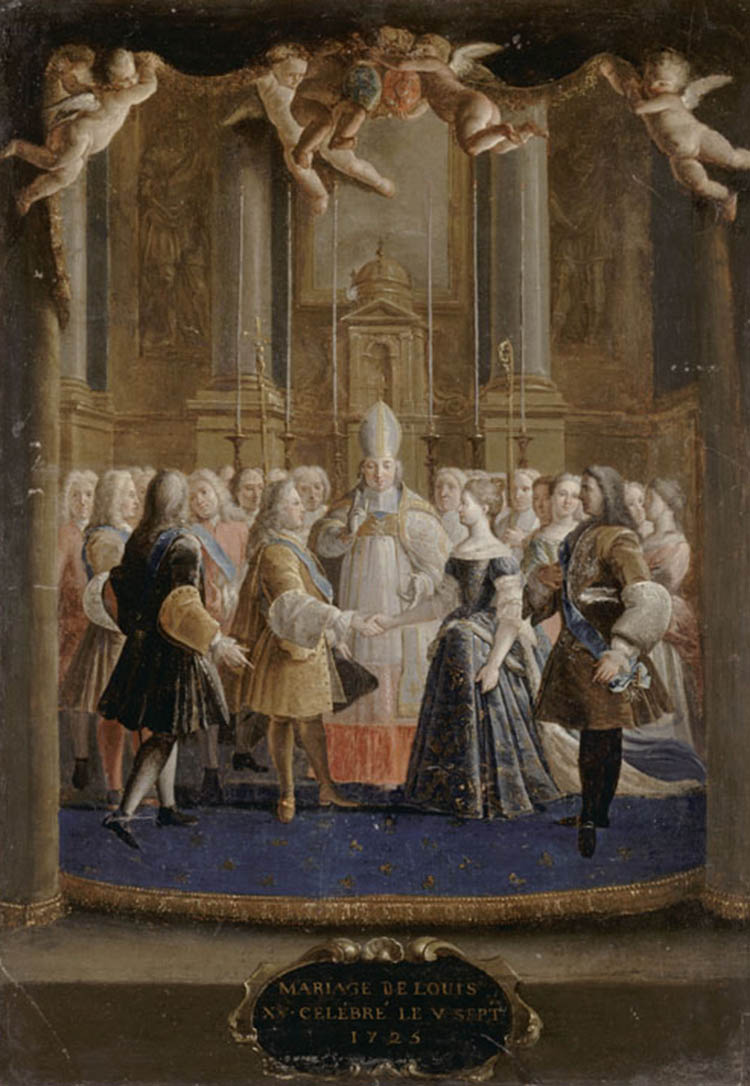
Marie Leczinska and Louis XV were married in Fontainebleau on the 5th of September 1725. Many rumors circulated, that she was ugly, Polish, steril, dull, an old maid - at the age of 22 (the King was 15). However Marie spoke six languages, danced gracefully and had received a full education. The first years of the mariage were happy. Louis XV, when he was 23 years old, became bored of Marie who was exhausted from her many pregnancies (10). The king thus found his first mistress, the Countess of Mailly, who became the famous marquise de Pompadour. Unfamiliar with the court etiquette Marie had also lacked an interest in politics, which did not please the King. In 1726, when she called the King to help the Duke of Bourbon who was damaging his reputation, she lost all political influence to her husband. Slowly, Louis XV who had sincerly loved his queen, neglected her completely. She remained however very attached to him.
Marie Leczinska lived in Versailles, surrounded by an intimate group of courtisans, with her own salon like those in fashion at the time, adapting to the morals and customs of the Court, playing her role and enjoying a degree of freedom unknown to any other Queen of France. She loved music and painting, painting water colour paintings herself - one of her paintings "a farm" is in Versailles. She invited Farinelli, the castrato, to Versailles in 1737 who gave her music lessons, as well as inviting the young Wolfgang Amadeus Mozart in in 1764. The people refered to her as the "good queen" because of her philanthropy, her goodness and her generosity towards the needy.
The Illustration of the monarchy
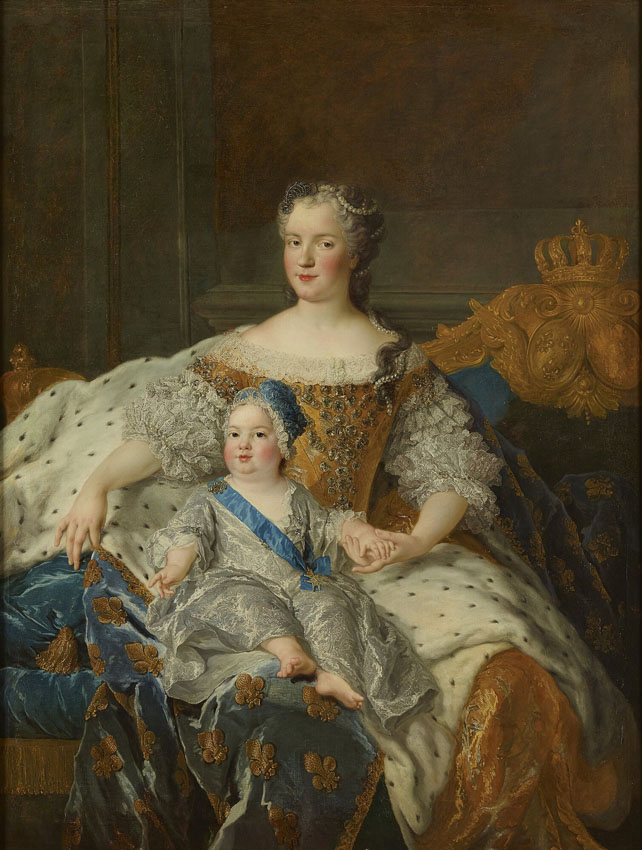
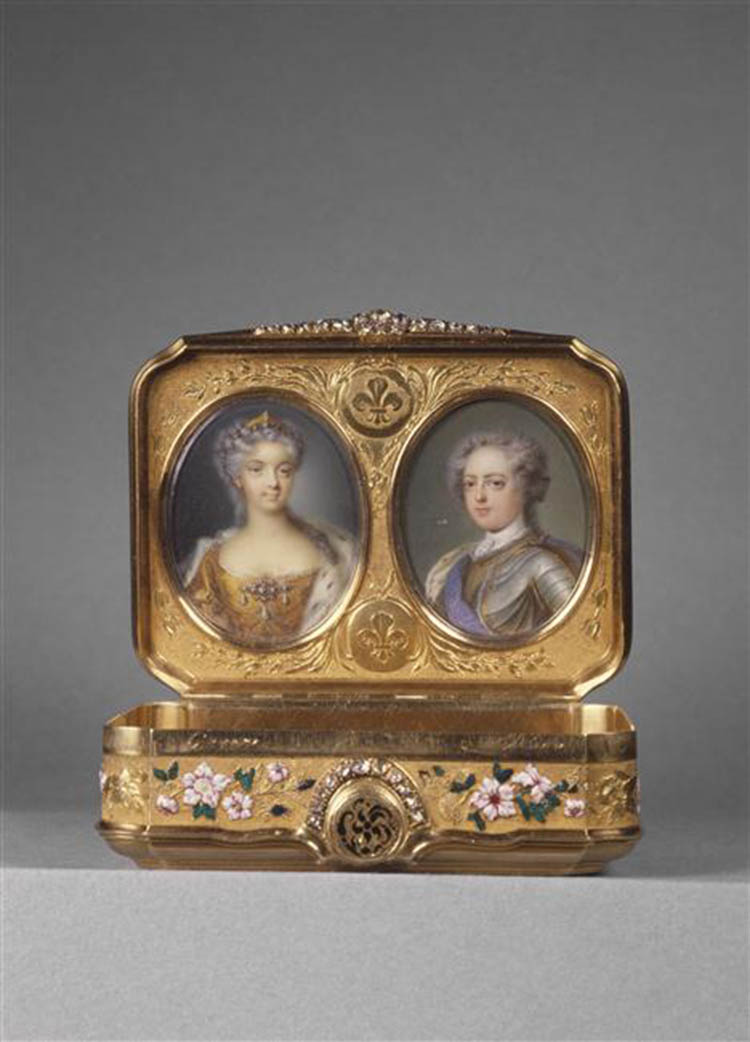
During the eighteenth century, before the invention of photography, royal portraits were primarily used to make the monarchs' faces commonly known. In order to diffuse them across the country, the original paintings were made into engravings, the medium of choice for transportable, inexpensive art.
These engravings were then used by artisans who made copies of them under various forms, such as snuffbox lids, paintings, sculptures on wooden panels… These objects were usually custom-made for private individuals who were looking to prove their allegiance to the King and to the Royal family. This is the case for our two iron firebacks featuring Marie Leczinska (ref.: 9397 et 10285).
During the nineteenth century, the issue of the Restauration, or restoration of the monarchy, along with the taste for Historicism, led to a larger production of objects featuring portraits of monarchs.
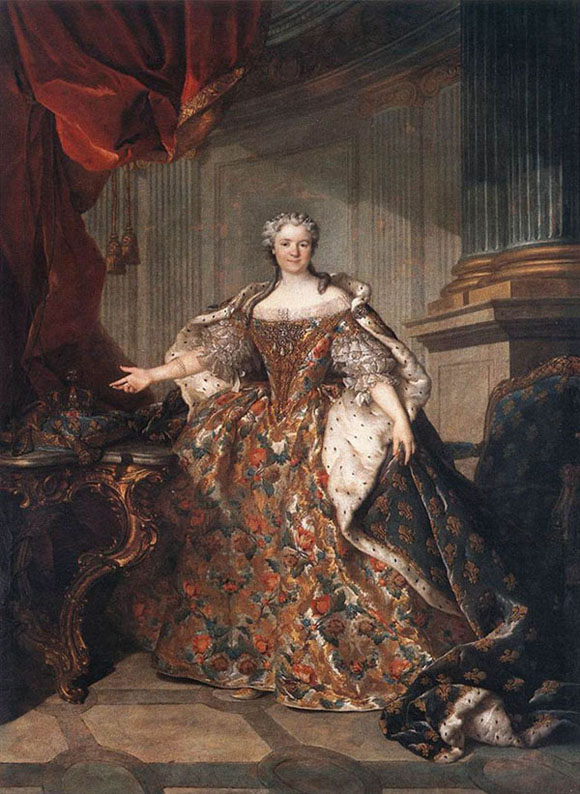
- Illustration: Portrait of Marie Leczinska, Louis Tocqué, 1740, Louvre museum.
Louis Tocqué (1696-1772) was a student of Nicolas Bertin and Hyacinthe Rigaud. He was licensed at the Academy on August 13th, 1731. From 1737 to 1759, he sent fifty portraits to the Academy exhibitions. He was Jean-Marc Nattier's son-in-law, and was one of contemporary high-society's favorite painters, along with Largillière. In 1757, Empress Elizabeth invited him to Russia where he lived for two years and made the sovereign's portrait. He then painted the portraits of the king and queen of Denmark, and after that he traveled to the courts of northern Europe, where he was received with a lot of pomp.
The large official portrait of Queen Marie Leczinska kept at the Louvre museum was painted in 1740. Marie Leczinska is standing and wearing a coronation coat and a dress adorned with an Indian motif. Her right hand indicates her crown that is set on a cushion with fleurs de lys (lilies), the French royal flower. The crimson drapes are drawn and give the portrait a theatrical sense. Moreover, the Queen is surrounded by ornate architecture, with a console and an armchair made of gilded wood, which goes along with the Queen of France's status.
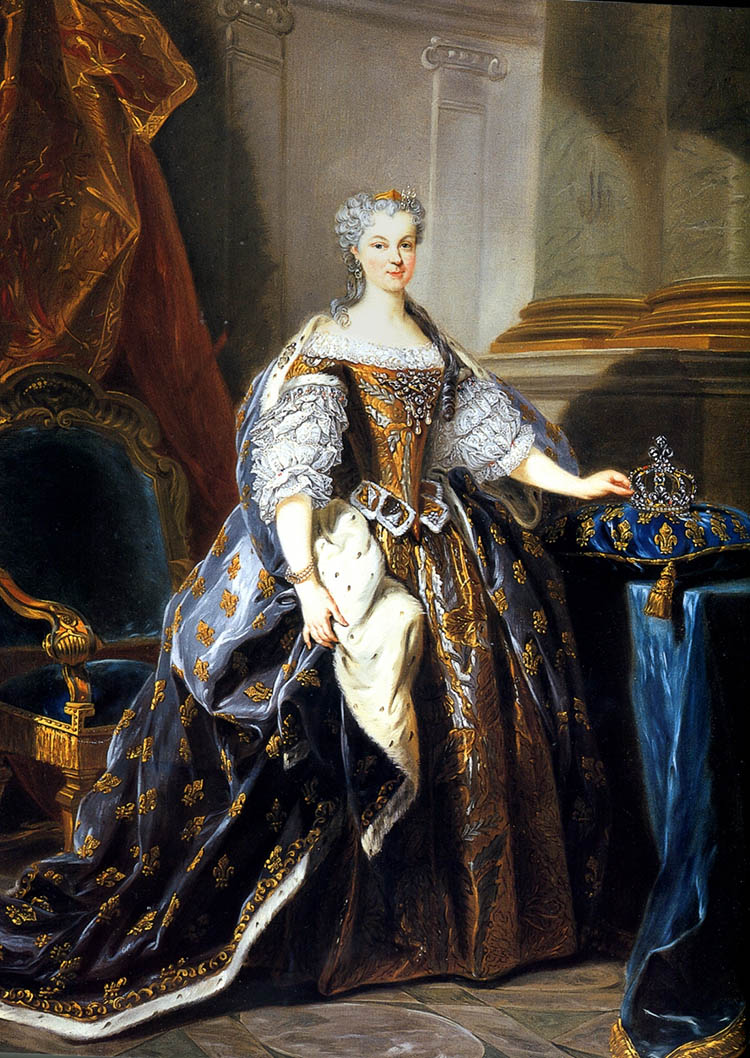
Fifteen years earlier, around 1725, painter Jean Baptiste Van Loo (1684-1745) had made the first portrait of the young Queen of France. He already used the hand gesture toward the crown which indicates her high rank.
Bibliography
- Michel Antoine, Louis XV, Ed. Fayard, 1989.
- Simone Bertière, The Queen and the Favorite, Marie Leszczynska, Madame de Pompadour, Ed. de Fallois, coll. “Les reines de France au temps des Bourbons", 2000.
- Irena Tatiboit et Ambroise Perrin, We have to marry Maria, Madame Louis XV, Princess of Wissembourg, Ed. Bourg Blanc, 2012.