Louis XIII period
Download PDFFirst half of the 17th century.
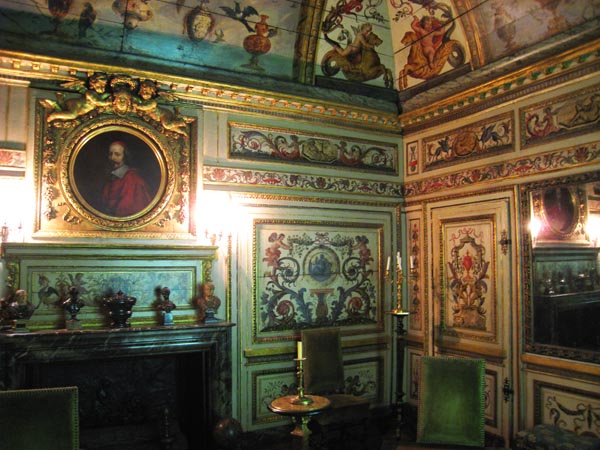
The Louis XIII style appeared during the reign of Henri IV. Paris thus became the capital of French creation, the country was entering a new era of prosperity and artistic splendor and the king ensured the establishment of a manufacturer of tapestry in Gobelins, in a tapestry workshop installed along the Bièvre river. Artistic experiences and stylistic interests diversified, inspired by Italian Baroque, but also Flemish furniture, large fireplaces carved completely out of stone were particularly popular but also decors painted all over their surface. Preceding Louis XIV's arrival to power, this period of political change also gave birth to a new art that suited the political situation of the time, brilliant and multiple.
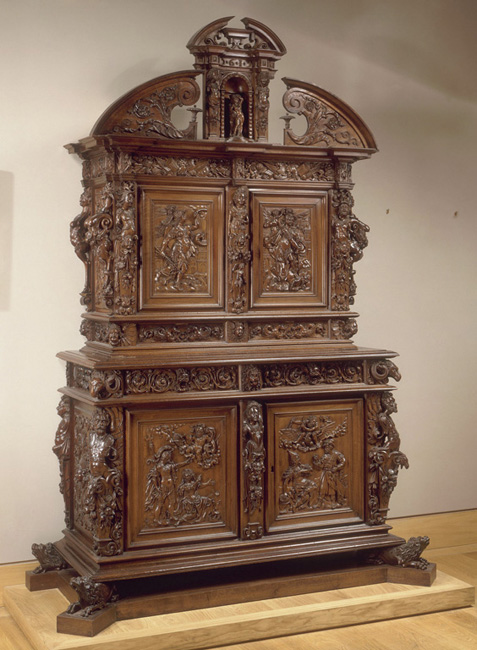
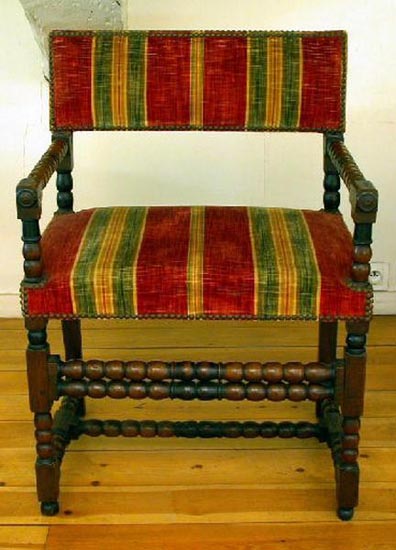
After the bloom of the Renaissance style, ornamentation was lacking, and sometimes geometric. Some of the distinctive elements of the Louis XIII style were diamond shaped sculptures and Maltese crosses. The mechanics of the lathe was perfected, and developed twisted columns, balustrades, chaplets for the bottom of tables, cabinets, chairs, armchairs, with armrests with a woman's head carved from a single block of wood, lion's muzzle or other little characters. Spools and rotors were frequently used as decorative attributes, cabinets and chests had flattened round feet.
The seats were covered with tapestry or velor, coming from or inspired by Italy, like the velours de Gêne. The colours red and green were particularly popular. Seats were also covered in leather, held together by large round nails in wrought iron or in gilded or silvered bronze.
Solid oak and walnut were particularly popular. Wood started to be imported, like ebony, which was often used for thick veneer, or the gaïac antillais in which the texture is particularly well suited for woodturning.