Emile Galle (1846-1904)
Download PDFÉmile Gallé is one of the most significant figures in the decorative arts of his time and one of the pioneers of Art Nouveau. A glassmaker, but also a ceramist and a cabinetmaker, a chemist as much as a botanist, he established in some thirty years a decorative vocabulary drawn entirely from nature. Founder and first president of the École de Nancy, he made Lorraine a centre of creation whose influence reached far beyond France.
A family of art and commerce
Émile Gallé was born in Nancy on 4 May 1846. His father, Charles Gallé, was a painter by training and a master of the delicate art of enamelling. His marriage to Fanny Reinemer, who came from a family of dealers in earthenware and crystal, shaped his career: the firm became "Gallé-Reinemer" in 1855, and Charles took sole charge of it the following year. At first no more than a trading and decorating house, it commissioned its pieces from the Parisian manufactories of Saint-Denis and Pantin, then worked as a subcontractor with the Meisenthal glassworks. Charles Gallé specialised in coloured glass, enamelled and cut in the manner of Bohemian crystal, and met with such success that from 1854 the various residences of Napoleon III placed orders with him. In 1867 he opened his own glass-engraving workshop in Nancy.
It was in this environment, where art and commerce were inseparable, that Émile received an education at once attentive and adventurous.
The training of a scholar
After secondary studies at the lycée in Nancy, crowned by the baccalauréat, the young man left in 1865 for Weimar to learn German, where he also pursued studies in mineralogy. He then learned the glassmaking trades at the Meisenthal glassworks in the Moselle, where he studied the chemistry of glass and practised blowing himself, and ceramics at the Saint-Clément earthenware factory. He spent time in London in 1871, which allowed him to learn English and to visit the English crystal works.
To this technical training was added an uncommon knowledge of natural history. A pupil of the physician and botanist Dominique-Alexandre Godron, Gallé sustained a lifelong passion for the natural sciences and for plants, which led him to drawing and to which his long-overlooked work on the plant world still bears witness. Chemistry, mineralogy, botany: he approached the decorative arts as a scholar as much as an artist, and this double competence explains the scope of his later research.
From 1863 he worked as an ornamental designer alongside his father. In 1867 he joined the management of the family glassworks and represented his father at the Paris Universal Exhibition, where he received an honourable mention for glass. He won a gold medal at the Lyon Universal and International Exhibition of 1872, in the class for porcelain and crystal. In 1877 he took over the family business in his own name.
Earthenware
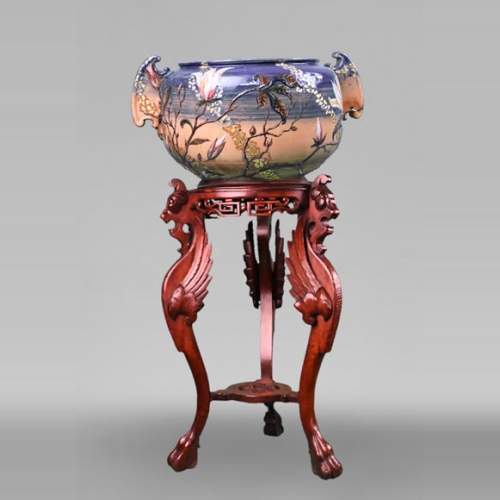
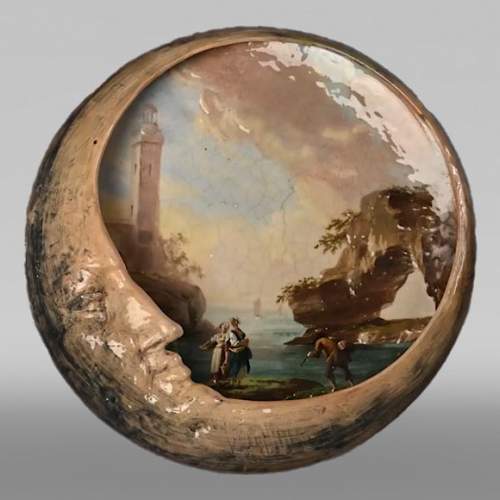
Gallé was a ceramist first. He joined his father in his work for the Saint-Clément earthenware factory around 1868, developing models inspired by the Louis XV and Louis XVI styles, but also more unexpected pieces: anthropomorphic earthenware, fantastical animals, objects in which humour vies with heraldic erudition. This body of work still earned him a gold medal for ceramics at the Universal Exhibition of 1889.
Favouring art glass, however, which was more sought after, Gallé gradually abandoned earthenware in the second half of the 1890s. His ceramics nonetheless form an entire branch of his work, today held in museums throughout the world and notably at the Musée de l'École de Nancy.
Glass and the Universal Exhibitions
Between 1867 and 1894 the Meisenthal glassworks served as Émile Gallé's laboratory, where he carried out technical and artistic research without precedent. Success came in stages. At the Universal Exhibition of 1878 it was the cobalt-tinted glass known as "clair de lune" that drew attention. At the Exhibition of Earth and Glass in 1884, he accompanied the pieces he showed with a note on materials and forms, revealing the extent of his chemical research and of his experiments with enamels.
Recognition came at the Universal Exhibition of 1889, where he received three awards — for his ceramics, his glass and his furniture, including a Grand Prix for glass — and where he was promoted Officer of the Legion of Honour. He would triumph again at the Universal Exhibition of 1900.
On 29 May 1894 he lit the furnace of his own crystal works in Nancy, on the avenue de la Garenne. The premises now formed a complete enterprise: a hall equipped with a four-pot furnace and ten glassmakers' stations, and two decorating workshops devoted to wheel engraving, acid etching and enamelling, facing the 1885 building that housed the cabinetmaking and ceramic workshops. On the solid oak door carved by Eugène Vallin with chestnut leaves, Gallé had his motto engraved: Ma racine est au fond des bois — my root lies deep in the woods.
The inventions
Gallé's production was blown, in glass and above all in crystal, that is with the addition of lead salts. Although he knew the technique of pâte de verre, he did not practise it — that was the domain of the Daum brothers, of Amalric Walter and of Décorchemont.
His technical vocabulary rests on a few processes, often combined within a single piece. Cased or multi-layered glass superimposes several layers of colour, which acid etching then cuts back to reveal the design in relief, on the principle of the cameo applied to glass. Wheel engraving, slower and more costly, was reserved for exceptional pieces. Intercalaire decoration traps the motif between two layers of material.
His research led to the filing, on 26 April 1898, of two patents: one for a "type of marquetry in glass or crystal", which consists in inserting fragments of coloured glass hot into the still-molten gather, and one for a "type of decoration known as patina on crystal and glass". Glass marquetry was presented that same year at the Salon du Champ-de-Mars in Paris.
To these processes was added a very personal practice: the verreries parlantes, or speaking glass, pieces engraved with a line of verse by Baudelaire, Hugo, Verlaine or Marceline Desbordes-Valmore, chosen to echo the decoration. In Gallé's work the flower is never mere ornament: it carries a meaning, often symbolist, sometimes political.
Cabinetmaking
In 1885, Gallé extended his activities to furniture and had the cabinetmaking workshops of the avenue de la Garenne built. He applied the same principles there as in glass: forms drawn from the plant world, and marquetry of unprecedented ambition, combining numerous woods — oak, walnut, ash, plum, exotic species — with applied materials such as mother-of-pearl and metal. The furniture frequently carries the same naturalist repertoire as the glass, and sometimes the same poetic quotations. His furniture earned him one of the three awards of 1889.
The École de Nancy and political commitment
Engaged from an early stage in the renewal of the decorative arts, Gallé distributed quality production pieces widely thanks to the industrialisation of part of his output. He opened sales depots in Frankfurt in 1894 and in London in 1901, his principal agent being Marcelin Daigueperce in Paris from 1879, succeeded by his son Albert in 1896.
In 1901 he founded the Alliance provinciale des industries d'art, better known as the École de Nancy, whose statutes he drafted himself and of which he became the first president. The project was explicitly industrial as much as artistic: to place art at the service of production and to make Lorraine a centre of creation. He gathered around him Louis Majorelle, the Daum brothers, Jacques Gruber, Eugène Vallin and Victor Prouvé.
The man cannot be reduced to the artist. A convinced Dreyfusard, in 1897 he founded the Nancy branch of the French League for the Defence of Human Rights with Hippolyte Bernheim and Charles Keller. Several of his verreries parlantes bear the mark of this commitment.
Émile Gallé died in Nancy on 23 September 1904, at the age of fifty-eight.
The firm after Gallé
The crystal works did not die with its founder. His widow, Henriette Gallé (1848-1914), took over the direction of the Établissements Gallé and continued production. As a sign of mourning, the firm then placed a small star before the signature, a practice used systematically until 1906 and more rarely until 1914. The signature itself became standardised and lost the artist's first name: it now designated the Maison Gallé rather than the glassmaker. During Émile Gallé's lifetime he did not in fact sign his pieces himself, but entrusted the task to his engravers and decorators, personally choosing the model of the signature for prestige pieces — more than a hundred variants are recorded, among them the wording "Cristallerie d'Émile Gallé à Nancy", which appeared in 1894.
On the death of Henriette Gallé, the direction passed to Paul Perdrizet. After the war he introduced a new signature, horizontal and openly engraved, never used in the founder's lifetime, in order to distinguish post-war production. The Établissements Gallé continued in activity into the 1930s.
Legacy
Works by Émile Gallé are held in numerous institutions: the Musée de l'École de Nancy, the Musée des Beaux-Arts in Nancy, the Musée d'Orsay and the Petit Palais in Paris, the fine arts museums of Lyon and Reims, the Musée Fin-de-Siècle in Brussels and the Walters Art Museum in Baltimore. His model of art applied to industry, and his influence on the whole generation of the École de Nancy, left a lasting mark on the French decorative arts.
See also
Art Nouveau — Japonism — Crystal — The Sarreguemines manufactory — The Sèvres manufactory — The 1889 Universal Exhibition — The 1900 Universal Exhibition
See our ceramics, earthenware and porcelain
Bibliography
Writings by the artist
Émile GALLÉ, Écrits pour l'art. Floriculture, art décoratif, notices d'exposition (1884-1889), collected by Henriette Gallé-Grimm, Paris, Renouard, 1908.
Monographs
Philippe GARNER, Émile Gallé, Paris, Flammarion.
Alastair DUNCAN and Georges de BARTHA, Glass by Gallé, London, Thames & Hudson, 1984.
Exhibition catalogues
La main aux algues et aux coquillages : le testament artistique d'Émile Gallé, exhibition catalogue, Paris, Musée d'Orsay, 2004.
Émile Gallé : nature et symbolisme, influence du Japon, exhibition catalogue, Vic-sur-Seille, Musée départemental Georges de La Tour, 2009.
Reference institutions
Musée de l'École de Nancy, City of Nancy — collections and documentation on Émile Gallé and the Alliance provinciale des industries d'art.
Musée d'Orsay, Paris — collections of glass and ceramics by Gallé.
Public collections cited
Musée de l'École de Nancy · Musée des Beaux-Arts, Nancy · Musée d'Orsay, Paris · Petit Palais, Paris · Musée des Beaux-Arts, Lyon · Musée des Beaux-Arts, Reims · Musée Fin-de-Siècle, Brussels · Walters Art Museum, Baltimore.