


Style Japonism, Chinoiserie / Ref.16060
Jean-Pierre TAHAN & Joseph CREMER, two-part carved buffet with marquetry panel called “Fantasy Furniture” Exhibition 1855
Dimensions
Width: 109 cm / 42'' ⅞
Height: 237 cm / 93'' ¼
Depth: 54 cm / 21'' ¼
Origin:
French, 19th century
This piece, presented at the 1855 Universal Exhibition, is the fruit of the work of two great French cabinet-makers: Joseph Cremer and Jean-Pierre Tahan. The former is regarded as one of the most important marquetry craftsmen of his time, while the latter is none other than the official cabinet-maker to Napoleon III, excelling in the production of precious furniture. This cabinet is an exceptional and rare piece, both for its quality of execution and for its genesis.
The marquetry panel was made in 1851 and presented that same year at the Universal Exhibition, set within a double-body piece of classical design. The composition of the marquetry is by Eugène Jean Brandely, recognised for the particular quality of his drawings. At the close of the 1851 Universal Exhibition, Cremer was awarded a second-class medal for his works as a whole.
The panel was presented again in 1855 at the Universal Exhibition, now set within a piece with exceptional sculpted vegetal decoration, made that same year by Jean-Pierre Tahan. This masterful carved setting with novel forms showcased Cremer's work and constitutes one of the very first pieces of furniture with such ornamentation. Anticipating by nearly forty years the forms of Art Nouveau, Tahan designed this carved decoration in harmony with Cremer's piece, to sublimate the exotic atmosphere it conveys.
The marquetry panel depicts an ibis at the edge of a watercourse, set in a scene of lush vegetation. At the heart of a tropical forest, the bird steps into the water with one foot on dry land, and one discerns the tortuous and languid course of the stream. In the upper register, lianas stand out from the canopy of an exotic tree, while the separation between earth and sky is rendered in a summary yet effective manner through a light wood background and a dark wood background.
The quality of execution and the degree of finish are exceptional: Cremer uses all the resources of the material to give depth and nuance to the composition, as attested by the play of shadow and light on the leaves, or the skilful combination of dark and light areas to render the subtle effects of the expanse of water. In concert, Brandely's drawing and Cremer's technique create a landscape of rare evocative power, in which the lush atmosphere of a tropical forest is conveyed with intensity, whether through the play of light, the stylised representation of exotic plants, or the singular presence of the bird.
The door of the lower register depicts a tangle of branches and reeds, while the pilasters represent thick and gnarled trunks whose bases are covered with broad leaves. Their branches rise up to the entablature and shelter nests. The upper register houses the marquetry panel, now serving as a door. Framed by fine bamboo branches garnished with leaves, Cremer's work is bounded by imposing pilasters forming bamboo stems from which bunches of leaves fan out in rosettes.
The base of the pilasters is richly adorned with superbly carved exotic leaves and flowers. Finally, the pediment is formed of entwined branches bearing fruit and features at its centre a nest disputed by a squirrel and a bird. The pose, captured from life, and the startled attitude of the animals complete the impression that the entire carved ensemble pulsates with life.
Exhibited at the Tahan stand, this cabinet was awarded a prize at the 1855 Universal Exhibition. This piece is a true masterpiece of French Second Empire cabinet-making, in which the virtuoso work of Joseph Cremer is enhanced by the vegetal decoration of Jean-Pierre Tahan. The piece is signed « Tahan à Paris Exposition 1855 » on the lock and « J. Cremer 1851 » on the panel.
Informations
Price: on request
Recommended for you :
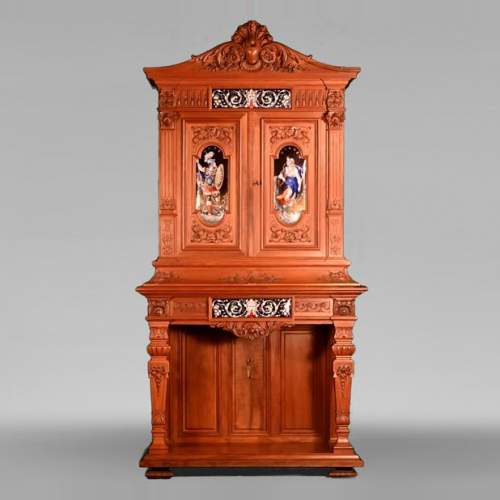
Dimensions:
Width: 107
Height: 211
Depth: 47
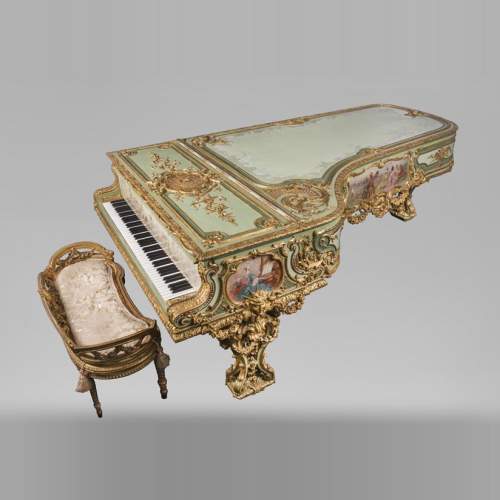
Dimensions:
Width: 275
Height: 109
Depth: 155
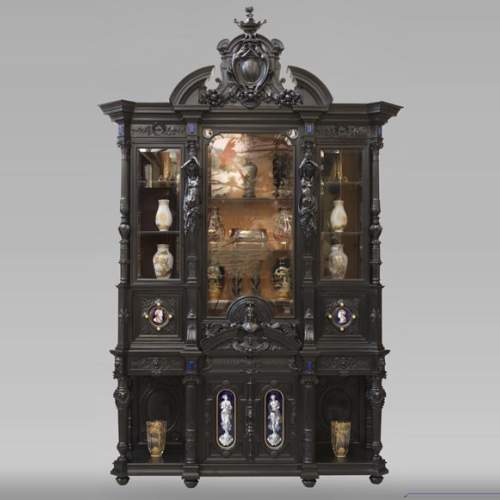
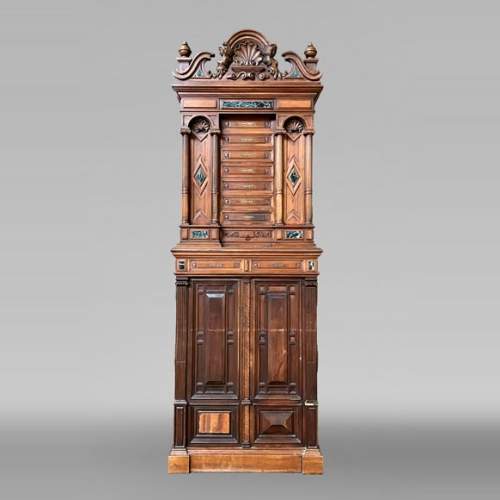
Dimensions:
Width: 122
Height: 344
Depth: 65
Dimensions:
Width: 149
Height: 215
Depth: 48
Dimensions:
Width: 98
Height: 204
Depth: 43

Dimensions:
Width: 143
Height: 255
Depth: 54
Dimensions:
Width: 72
Height: -1190
Depth: 42
Dimensions:
Width: 141
Height: 73
Depth: 70
Dimensions:
Height: 228
Diameter: 88
Dimensions:
Width: 130
Height: 182
Depth: 24
Dimensions:
Width: 78
Height: 186
Depth: 47