Philippe-Joseph Brocard (1831-1896)
Download PDFPhilippe-Joseph Brocard, born in 1831 and died in Meudon in 1896, is one of the great glass craftsmen of the Second Empire and the Third Republic. A restorer of antiquities turned glassmaker, he rediscovered the hard polychrome enamels of the glassmakers of Syria and Egypt (13th-14th centuries) and made them one of the emblems of the historicist and Orientalist taste of his time. Regarded as a forerunner of the École de Nancy and of Art Nouveau, he influenced Émile Gallé.
From restorer to glassmaker
Brocard began his career as a restorer and collector of works of art. Between 1850 and 1860 he worked notably for the Rothschild collections and for the Musée de Cluny, where he discovered the Mamluk mosque lamps. Fascinated by these pieces, he collected them himself. His workshop was on the Faubourg Saint-Honoré in Paris.
Reviving Islamic enamels
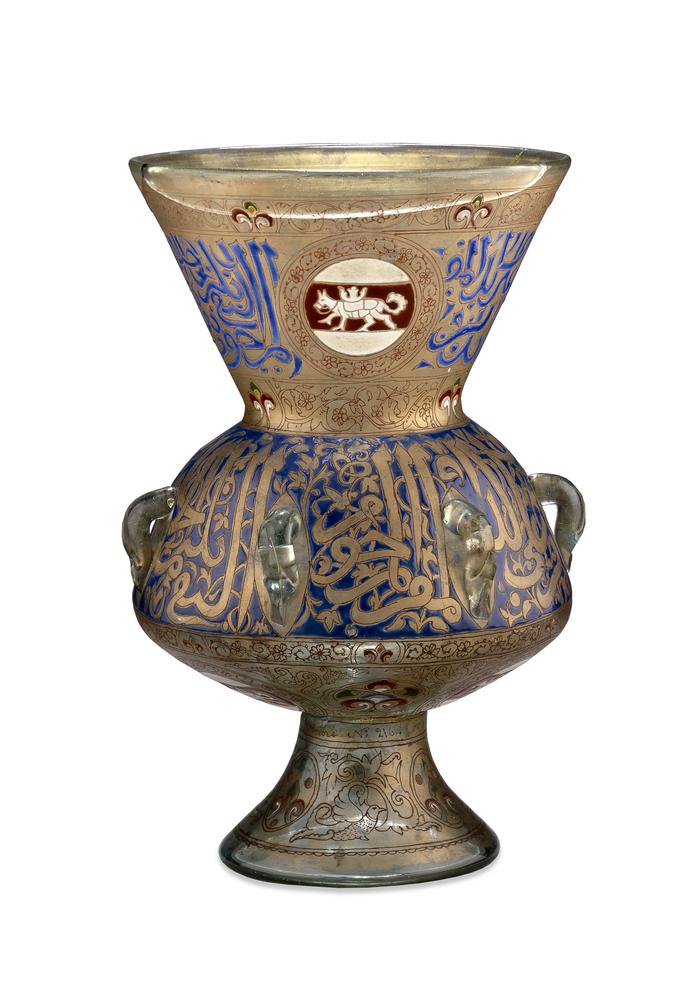
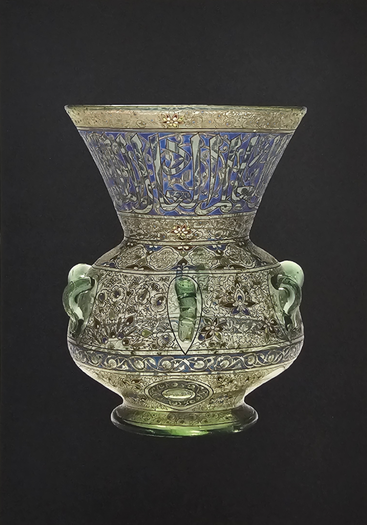
From the 1860s Brocard rediscovered the methods of the medieval glassmakers of the East: coloured enamels, opaque or translucent, applied with a brush and fired onto free-blown glass, heightened with gilding, arabesques and Kufic-style inscriptions. His imitations of mosque lamps, cups and goblets are so faithful that they are sometimes mistaken for the old models, even though, as the British Museum points out, he sometimes altered or misunderstood elements of his sources.
He exhibited at the Paris Exposition Universelle of 1867, then in London (1871), Vienna (1873) and again in Paris in 1878. The Louvre Abu Dhabi holds one of his blown, enamelled glass mosque lamps of 1871; the British Museum another, made in Paris in December 1867.
Towards a freer style
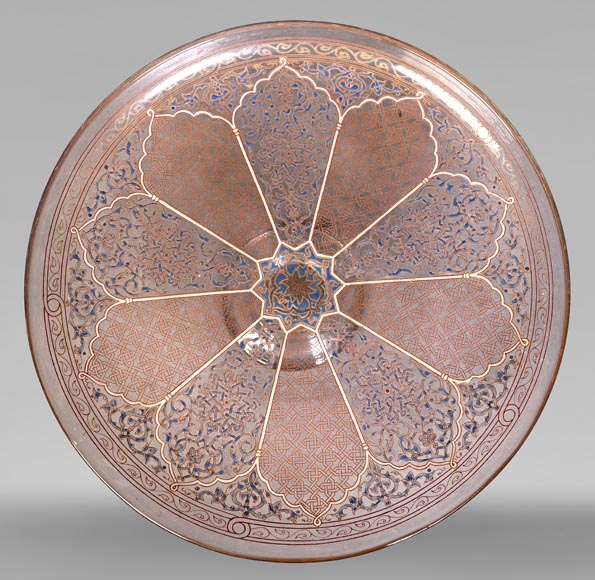
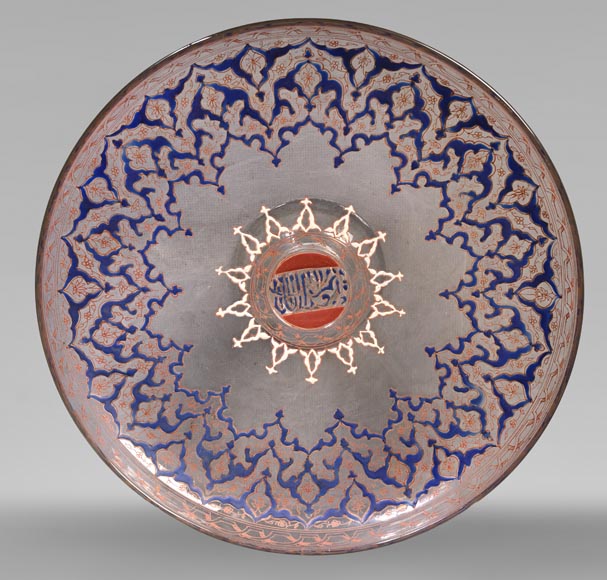
After meeting Émile Gallé, around 1878, Brocard's style became freer and more naturalistic. He painted clear glass in a "Persian" taste, with geometric and stylised floral ornament, then in his last years made vases in the spirit of ceramics, medieval phials and Renaissance bowls, with large flowers and foliage influenced by Chinese and Japanese art. He patented his enamelling method in 1891.
The Brocard firm
His son Émile joined the business, which took the name "Brocard et fils"; after Philippe-Joseph's death in 1896 it continued as the Verrerie Brocard until 1904 according to the British Museum. Brocard's glass is today found in major collections, among them the British Museum, the Louvre Abu Dhabi and the National Gallery of Victoria in Melbourne.
See also: Émile Gallé — Art Nouveau — Japonisme — Louis Majorelle
See our 19th-century objets d'art
Bibliography
Institutional sources
The British Museum, London, mosque lamp decorated by Philippe-Joseph Brocard, Paris, December 1867, inv. 1902,1118.1 (biographical note on Brocard).
Louvre Abu Dhabi, Glass vessel in the shape of a mosque lamp, Joseph Brocard, Paris, 1871, blown and enamelled glass, inv. LAD 2012.011.
National Gallery of Victoria, Melbourne, entry "Philippe-Joseph Brocard" (enamelled glass).
Museum-digital, person record "Philippe-Joseph Brocard (1831-1896)" (dates and places of birth and death, after French Wikipedia).
Online resources
"Philippe-Joseph Brocard", Wikipedia (French version); entry "Philippe-Joseph Brocard", mcdesarts.com (glass collection).