


Style Symbolism / Ref.16201
Charles-Édouard MAUGENDRE-VILLERS (1852-1922), Votive Triptych to the Virgin Mary, Protector against the Plague
Dimensions
Width: 211 cm / 83'' ⅛
Height: 172 cm / 67'' ¾
Depth: 12 cm / 4'' ¾
Origin:
Oils on canvas mounted on board, 1897
An important religious triptych composed of three oil paintings on canvas mounted on the panels of an oak cabinet with hinged doors, each signed by Charles-Édouard Maugendre-Villers (Cuy-Saint-Fiacre, 1852 - Lille, 1922) and dated June 1897. A painter and sculptor trained under Augustin Dumont, Gabriel-Jules Thomas, and Albert-Ernest Carrier-Belleuse, the artist exhibited at the Salon from 1879 onward and distinguished himself particularly through his religious and commemorative works. The central panel depicts the Virgin in Majesty, seated on a radiant golden throne like a halo, dressed in a pink robe and a blue mantle. Above her, cherubs carry in a cloud the closed crown and scepter, attributes of her celestial royalty. In her left hand, she holds a red cord restraining the Plague, depicted at the foot of her throne as a monstrous beast, its mouth muzzled by the same cord. This personification of the scourge, bound by Marian intercession, forms the heart of the iconographic program, explained by the Latin inscription carved on the base of the piece: "Per me pestilentia conflictis salus," meaning "Through me, salvation for those afflicted by the plague." Around the throne throngs a crowd of supplicants and those miraculously healed, dressed in light robes, among whom stand out a kneeling widow in mourning, a cleric, and a mother presenting her child. In the background unfolds a plain landscape dotted with church steeples. The side panels feature two standing angels whose opposition encapsulates the passage from plague to deliverance. On the left, a closed-eyed angel holds flowering branches above a field of lilies, symbols of purity and renewal, beneath a moonlit night sky. On the right, a helmeted and haloed angel sheathes his bound sword, a gesture signifying the end of punishment, in a landscape of thistles ablaze with the setting sun. This iconography likely alludes to the biblical episode of the angel of the plague sheathing his sword after David's supplication, and contrasts the lily with the thistle, dawn with dusk, grace with trial. The oak cabinet, whose two doors allow the triptych to be closed in the manner of ancient altarpieces, is carved at its base with unfurled banners bearing the votive inscription in Gothic script. The style, which combines the hieratic quality of primitive art with a clear palette of symbolist inspiration, places this work within the current of renewal of religious art at the end of the 19th century.
Informations
Price: on request
Recommended for you :
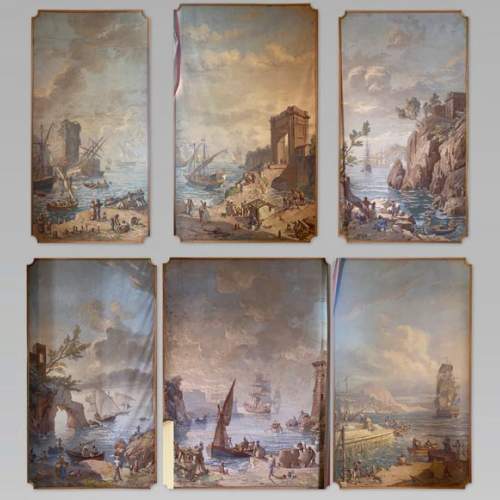
Dimensions:
Width: 122
Height: 240
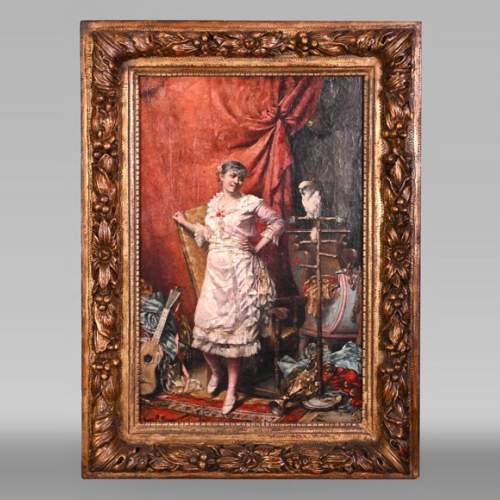
Dimensions:
Width: 43
Height: 63
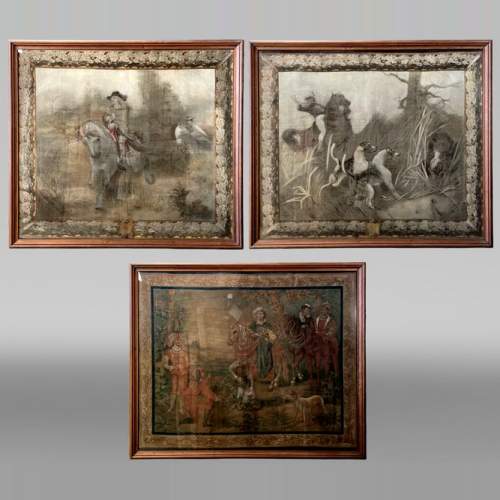
Dimensions:
Width: 264
Height: 216
Depth: 10
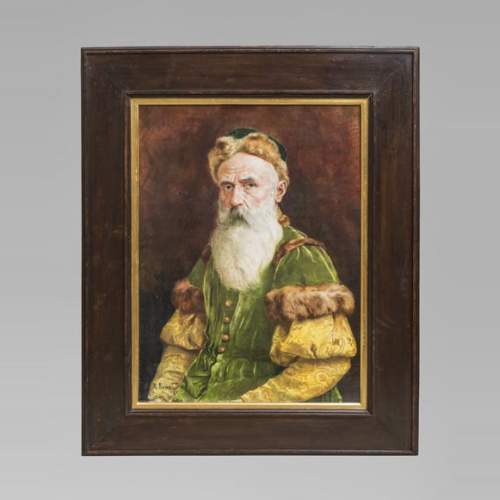
Dimensions:
Width: 86
Height: 108
Dimensions:
Width: 65
Height: 195
Depth: 3
Dimensions:
Width: 71
Height: 100
Depth: 6
Dimensions:
Width: 140
Height: 171
Depth: 4
Dimensions:
Width: 20
Height: 18
Dimensions:
Width: 32
Height: 41
Dimensions:
Width: 76
Height: 84
Dimensions:
Width: 67
Height: 95
Depth: 2
Dimensions:
Width: 108
Height: 94
Depth: 8