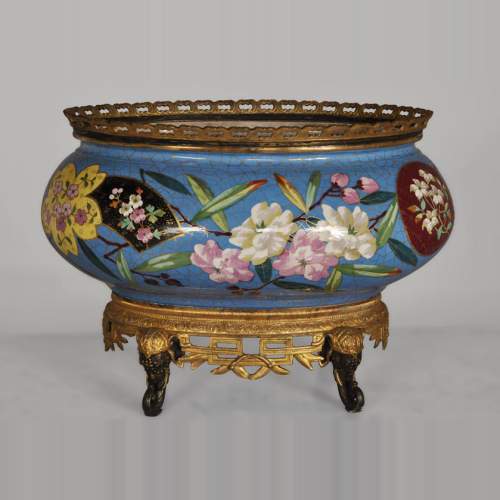
The Creil and Montereau Faience Works
Download PDFFounded in imitation of England, the faience works of Creil (Oise) and Montereau (Seine-et-Marne) merged in 1840 to form one of the largest fine-earthenware manufactories in France. With about 1,400 workers, they were, according to the town of Creil, second in the country behind Sarreguemines. Their name remains linked to pictorial plates: millions of examples decorated with popular images, series of twelve plates, captions and scenes from French history.
Creil: a foundation on the Oise (1797-1840)
The Creil manufactory was founded on 26 May 1797 (7 Prairial Year V) by the glass merchant Robert Bray O'Reilly, on the banks of the Oise. The early years were difficult, and the business was taken over by a group of shareholders who put Jacques Bagnall, an English potter born in Burslem in 1762 who had run the Chantilly porcelain works, in charge. Around 1811 Saint-Cricq Casaux took over the management; from 1816 he was sole owner. Creil employed up to about 800 people around 1811.
The manufactory adopted an industrial model inspired by England, based on scientific progress, to make up its technical lag: fine white earthenware, fine stoneware and soft-paste porcelain.
Montereau: an older site
At Montereau-Fault-Yonne, the making of fine earthenware began in 1749 in the Saint-Nicolas district. From 1774 an English partnership, Clark, Shaw et Cie, restarted production; it later became Hall, then Merlin-Hall. Between 1796 and 1805 a competitor, Christopher Potter (1751-1817), introduced transfer printing on earthenware from copperplate engravings to France.
In 1819 Saint-Cricq Casaux, already the owner of Creil, bought the Montereau manufactory.
The 1840 merger
Creil and Montereau merged in 1840. The following year Louis-Martin Lebeuf (1792-1854) and Jean-Baptiste Gratien Milliet (1797-1875) bought the whole, which operated as Lebeuf, Milliet et Cie. English directors, George Vernon father and son, notably introduced soft-paste porcelain. The manufactory received a first-class medal at the Paris Exposition Universelle of 1855.
At Creil, Henri Barluet (born 1802) ran the manufactory, developed the Saint-Médard workers' estate and served as mayor of the town. In 1862 he set up a sickness and old-age fund there. In 1866 Creil had 4,539 inhabitants, and the faience works employed 503 people.
The pictorial plates
The everyday production is famous for its printed plates, often accompanied by a title or short text: scenes from French history, military life, fables, rebuses, proverbs, trades, series of twelve plates sometimes numbered. They brought the popular image to the tables of millions of families. The faience works is even mentioned by Gustave Flaubert in L'Éducation sentimentale.
Decline and closure
After the death of Henri Barluet in 1884, the manufactory went into decline. The Creil works closed in 1895; its buildings were demolished in 1900 and a municipal park replaced them in 1901. Montereau carried on alone: in the 1920s (1920 or 1922 depending on the source) it was attached to the Choisy-le-Roi faience works, before closing in 1955; the buildings were abandoned, then destroyed, and the archives lost.
Where to see these faience pieces
Several hundred pieces of Creil fine earthenware are shown at the Maison de la Faïence in Creil, with temporary exhibitions and guided tours; the town's Musée Gallé-Juillet also holds pieces from the manufactory, including a black stoneware table service reminiscent of Wedgwood's basalt.
See also
The Choisy-le-Roi Manufactory — The Faïencerie de Gien — The Rubelles Faience Works — The Longwy Manufactory
See our ceramics, faience and porcelain
Bibliography
Institutional sources
Town of Creil, "La faïencerie, fleuron industriel", Creil en histoire, 2022 (creil.fr).
Musée Gallé-Juillet, Creil, presentation of the Creil and Montereau faience works (museegallejuillet.fr).
Online resources
"Creil-Montereau faience", Wikipedia.
Les Amis de la faïence fine, amisfaiencefine.fr.