


Style Other / Ref.15823
Decorative shield with high-relief decoration of the Creation to the Last Judgment after the Milton Shield by Léonard Morel-Ladeuil, Naples porcelain, known as Capodimonte porcelain
Dimensions
Width: 71 cm / 28''
Height: 80 cm / 31'' ½
Depth: 4 cm / 1'' ⅝
Origin:
Naples, last quarter of the 19th century. Period French mount
An oval shield in painted and enameled porcelain with high-relief decoration, mounted on a black boiled leather core entirely decorated with gilt scrolls, palmettes, and cartouches. The iconographic program faithfully reproduces that of the famous Milton Shield by the French goldsmith Léonard Morel-Ladeuil (1820-1888), presented at the 1867 Paris Universal Exhibition where it was awarded a gold medal and immediately acquired by the Victoria and Albert Museum in London. Electroplatings executed by Elkington & Co. of Birmingham were later produced and are in the collections of the Musée d'Orsay and the Metropolitan Museum of Art.
The iconography is inspired by John Milton's epic poem Paradise Lost, published in 1667, and unfolds the story of Salvation from Creation to the Last Judgment. At the center, in a circular medallion surrounded by a frieze of gilded scrolls, the archangel Raphael, draped in purple and haloed with a radiant nimbus, converses with Adam and Eve in the Garden of Eden, at the foot of a tree laden with roses and ferns, against a backdrop of a tropical landscape with banana trees. At the top of the shield, in a bracketed cartouche, the bust of God the Father, with a golden halo and surrounded by a crown of winged cherub heads emerging from the clouds, surmounts a winged hourglass inscribed within a circle, an allegory of the passage of time. At the lower point, as a counterpart, the archangel Saint Michael, armored in gold, slays the dark-winged dragon with his sword.
The two large lateral spirals depict the battles between the armies of Paradise and those of Hell. On the left, the celestial army mobilizes: trumpet-sounding angels, cohorts of soldiers in antique helmets with round shields emblazoned with stars and rosettes, a battle scene in which angels bearing spears intervene. On the right, in counterpoint, the fall of the rebel angels: a multitude of naked bodies rendered in grisaille heightened with blood red, hurled upon the clouds, surmounted by allegorical figures bearing the spear, the hourglass, and the sundial, under the eye of God the Father draped in purple. The two outer bands display a cosmological repertoire blending the signs of the zodiac (Cancer, Scorpio, Pisces, Saturn and its rings, comets) with the attributes of the liberal arts and the emblems of time (lyre, gong, crown, sundial). The two lower corbels depict the personification of Sin, a nude female figure holding a serpent and surrounded by reptiles, and Death, crowned and draped in purple, holding a scythe and letting an hourglass hang from her. In the upper spandrels, two pairs of embracing angels fly against a starry background.
The transposition of Morel-Ladeuil's goldsmithing design into the medium of Neapolitan porcelain is a remarkable and probably unique choice. Where the original combines chased copper and silver through electroplating, our shield translates the program into painted and glazed porcelain with a fine, translucent paste, in the tradition of 19th-century Neapolitan productions known as Capodimonte. The pearly flesh tones enhanced with a red border, the drapery painted in shades of pink, purple, green, and violet, and the accessories (armor, shields, musical instruments, hourglass, suns) rendered in gold relief, all reproduce with great virtuosity the sculpted modeling of the French original. The boiled leather mount, a technique characteristic of Parisian workshops during the Second Empire and the early years of the Third Republic, confirms the object's prestigious purpose and suggests a special commission for the Parisian luxury market.
Related works: Léonard Morel-Ladeuil, Ornamental Shield known as the Milton Shield, 1867 model, original in silver, Victoria and Albert Museum, London (inv. 546-1868); electroplating, circa 1880, Musée d'Orsay (inv. OAO 1773-1); electroplating, Metropolitan Museum of Art, New York.
Informations
Price: on request
Recommended for you :
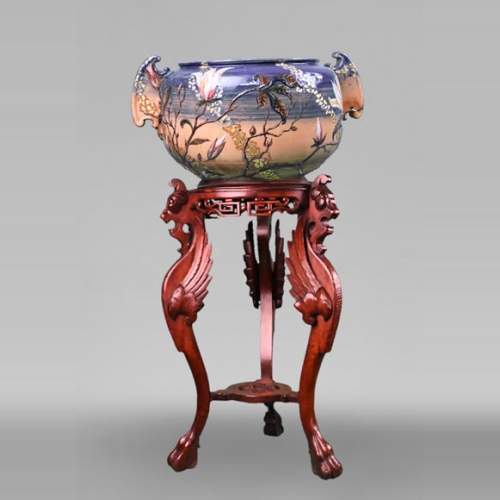
Dimensions:
Height: 113
Diameter: 58
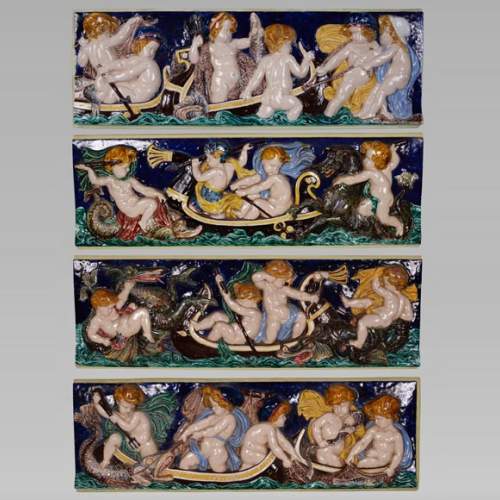
Dimensions:
Width: 80
Height: 27
Depth: 7
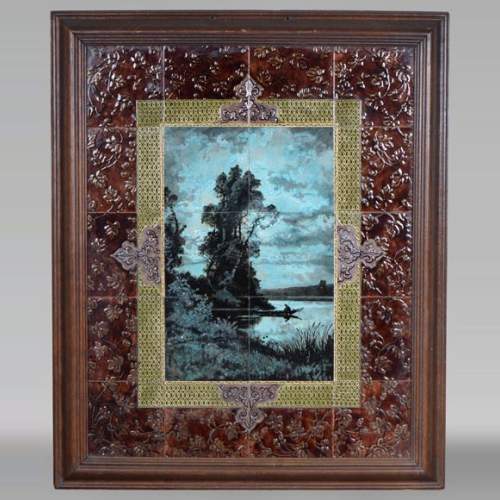
Dimensions:
Width: 96
Height: 116
Depth: 5
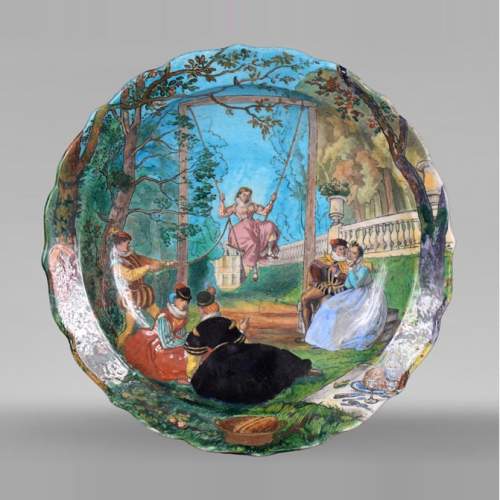
Dimensions:
Height: 8
Diameter: 41
Dimensions:
Height: 4
Diameter: 30
Dimensions:
Width: 69
Height: 69
Depth: 4
Dimensions:
Height: 5
Diameter: 80
Dimensions:
Width: 48
Height: 80
Depth: 3

Dimensions:
Width: 27
Height: 36
Dimensions:
Width: 30
Height: 17
Depth: 18
Dimensions:
Width: 23
Height: 91
Depth: 23
Diameter: 40