menu
Menu
account_box
Categories
Contact
email Send us a message

Contact us

phone By phone

+33 (0)1 42 25 12 79
Tue.-Sat., from 10am to 6pm
+33 (0)6 60 62 61 90
Everyday from 9am to 7pm.

email by Email

Adress: contact@marcmaison.com

share Let's get social

Languages
And also...
My selection
(7 Objects)
My selection (7 Objects)

Paul Berthier, Rebecca and Ruth, early 20th century

Ref.12083
Paul Berthier, Rebecca and Ruth, early 20th century

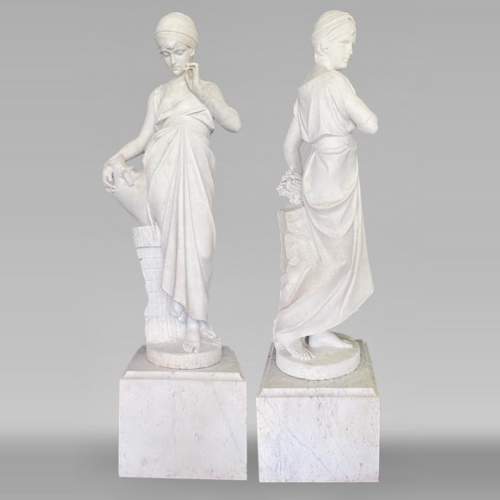
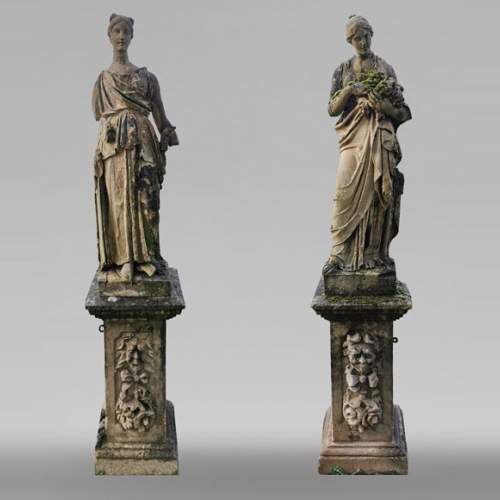
These two sculptures in marble were made by Paul Berthier in the early 20th century. Paul Berthier (1879-1916) was a pupil of two sculptors, Antonin Mercié and Victor Peter. He exhibited at the 1903 and 1904 Salons and received an honourable mention in 1904. His work is part of the Orientalism movement, with figures from the Maghreb and the Middle East, and animals representative of the fauna of these countries. The first of these two statues depicts a young woman standing by a well, holding a jug in her hand; she is dressed in a drape with light embroidery incised into the collar and lower fringe, and wearing a turban. Her name, Rebecca, is inscribed on the base. The second statue features a young woman dressed in the same way and carrying a sheaf of wheat at her side; the inscription refers to her as Ruth. The two statues correspond in their postures: Rebekah's hand is raised towards her lowered face, while Ruth's head is raised and she is looking straight ahead. Both are depicted in contrapposto. The names of the two young women refer to two biblical characters from the Old Testament: Rebecca is Isaac's wife, while Ruth is Boaz's wife. The first appears in the Genesis: Abraham sends his servant to find a wife for his son Isaac. He tells him that he will find her drawing water, and that he will recognise her because she will give him something to drink. The sculptor depicts the young woman as she is described in the Bible, dressed simply, with a few jewels. The full jug symbolises her intact virginity, and her lowered face refers to her modesty and shyness. The story of Ruth is told in the book that bears her name. Originally from the kingdom of Moab, Ruth marries Noemiah's son; now a widow, she moves to Bethlehem with her mother-in-law. At harvest time, they both glean ears of wheat from a field belonging to Boaz. Ruth is shown meeting Boaz, holding the ears of wheat she has just gathered in her left hand and trying to hide them with her right. Berthier sculpted two women from the Bible as they meet their future husbands. These iconographic themes can also be found in the work of other artists. In 1855, Pierre Antoine Hippolyte Bonnardel sculpted Ruth Gleaning (now in the Louvre), a statue of the young woman in action. In 1866, Giovanni Maria Benzoni created a veiled Rebecca, now in the Salar Jung Museum in India. Both statues bear witness to the influence of Orientalism on Berthier's work. However, the models for these two figures are clearly characterised by a European canon of beauty, as was often the case at the time. This oriental influence is reminiscent of that exerted on the art of Eugène Delacroix, whose female figures may also be turbaned and wrapped in a wide drape marked at the waist, as in Portrait of a Woman Wearing a Blue Turban or Greece on the Ruins of Missolonghi. Berthier's statues were therefore in keeping with the times, and with his contemporaries' pronounced taste for representations inspired by travel or accounts of journeys to the South or East. Like other artists, he did not have the opportunity to travel to these lands in person, but this did not prevent him from depicting a dreamlike, fantasised elsewhere.

Dimensions:
Width: 53 cm
Height: 149 cm
Depth: 52 cm

Albert ANKER (painter), Théodore DECK (ceramist), Ornamental Dish “Cleopatra”, 1869

Ref.14204
Albert ANKER (painter), Théodore DECK (ceramist), Ornamental Dish “Cleopatra”, 1869

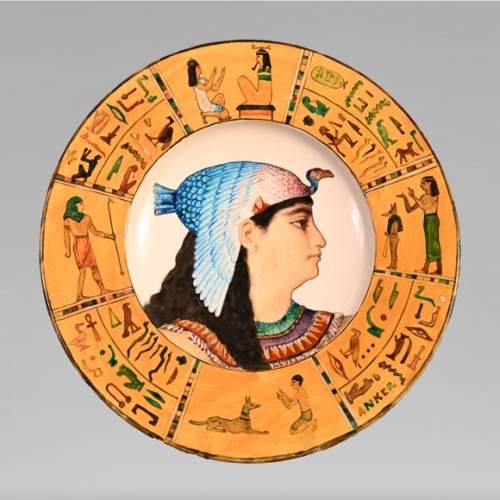
Biographies of Albert Anker and Théodore Deck The Swiss painter Albert Anker (1831-1910) joined the École des Beaux-Arts in Paris in 1855. Alongside his close collaboration with Théodore Deck, Anker distinguished himself in the genre of historical portraiture. Between 1866 and 1892, the two artists produced over 450 faience pieces together, combining their talents to create exceptional works. Théodore Deck (1823-1891) established himself in Paris in 1858. After manufacturing linings for heating systems, he turned to ceramics, a field in which he achieved rapid success. Constantly perfecting his technique, his production was highly acclaimed at the Universal Exhibitions. The ceramicist was made an Officer of the Legion of Honour in 1878 and directed the Sèvres Manufactory from 1887 until his death in 1891. His workshop frequently called upon renowned painters to design the decorations for his pieces. Description of the Work Executed in 1869, this Egyptian-style plate is the result of a long collaboration between Albert Anker and Théodore Deck. The center of the plate features a portrait of Cleopatra, depicted according to her image at the Temple of Hathor in Dendera. She wears the attributes of Egyptian nobility: the royal collar (ousekh) and the vulture, symbol of the goddess Nekhbet, protector of pharaohs and tutelary figure of Upper Egypt. Her posture and ornaments faithfully adopt the figurative codes of ancient Egyptian art. The decorations on the rim of the plate follow a precise archaeological style. Set against a yellow background characteristic of ancient Egyptian funerary objects, four scenes inspired by temple art stand out, punctuated by pseudo-hieroglyphs. These include a woman praying before a bearded god, the deity Seth carrying the was scepter, the god Anubis accompanied by a female worshiper, and a scene where Anubis is adored by a man. The subject and style of this decorative plate bear witness to Egyptomania, the fascination with ancient Egypt that spread through the 19th century and influenced European decorative arts. Deck and Anker produced several versions of this plate, examples of which are now held at the Gustav-Lübcke Museum in Hamm, the Kunstmuseum in Bern, and the Théodore Deck Museum in Guebwiller.

Dimensions:
Width: 33 cm
Height: 5 cm
Depth: 33 cm

Joseph Simon Volmar (Berne, 1796-1865), Pair of bears in cast iron

Ref.14989
Joseph Simon Volmar (Berne, 1796-1865), Pair of bears in cast iron

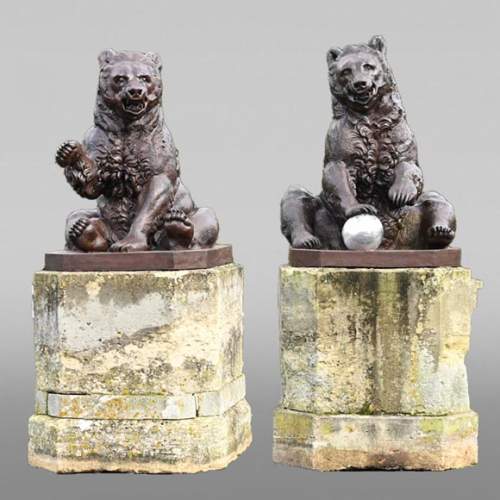
Joseph Simon Volmar (or Vollmar) (Bern, 1796-1865) was a Swiss painter and sculptor. Born to a painter father, he was his student at the Bern Art School and later studied in Paris between 1814 and 1824 under Horace Vernet, Théodore Géricault, and the sculptor David d’Angers. In 1836, he was appointed Extraordinary Professor of Academic Drawing and Oil Painting at the Bern Art School. His reputation extended beyond Swiss borders. Volmar was known for his historical, landscape, and animal paintings and sculptures. During the 19th century, an era marked by the emergence of national consciousness, he secured a significant public commission for the monument to Rudolf von Erlach (c. 1299-1360), the victor of the Battle of Laupen in 1339, which preserved the independence of the city of Bern on that occasion. The architect Gottlieb Debler, the caster Rüetschi von Aarau (for the equestrian statue), and the Bisontine foundry Gandillot et Roy (for the bears) collaborated with Joseph Volmar in the construction of the monument between 1841 and 1848. Its inauguration took place during the Laupenfest in 1849, and the monument is now located on the Grabenpromenade. The presence of bears serves as a reminder of the historical identity of the city. Two of the bears sculpted by Volmar were casted again through a private commission from the Marshal of Saxe, who likely admired the monument. Although the plate indicating their authorship and casting location is missing, a comparison with the monument allows us to attribute them to Volmar. These statues were likely cast in Besançon; since the Gandillot et Roy foundry was acquired by the Degoumois et Cie foundry in 1864, it is certain that the bears were cast before that date. The animals, with their varied poses, detailed fur, and great expressiveness, showcase the sculptor’s mastery of animal art. One, ferocious, bares its fangs and raises its paw as if to attack, while the other is more playful, with its ball and its almost smiling expression. In both cases, the sculptor paid great attention to the detailed representation of the animals’ fur. Volmar had the opportunity to observe bears since the city of Bern housed them, and his graphic work includes numerous representations of these animals. Thus, the bears created by Volmar for the monument to Rudolf von Erlach were so admirable that they served as models for a new casting intended for private use. To our knowledge, these bears are the only two examples that have been cast from the monument. Ours ENPublish at Calameo

Dimensions:
Width: 107 cm
Height: 224 cm
Depth: 121 cm

Théodore DECK, circular dish with eggplant base with swallows

Ref.15164
Théodore DECK, circular dish with eggplant base with swallows

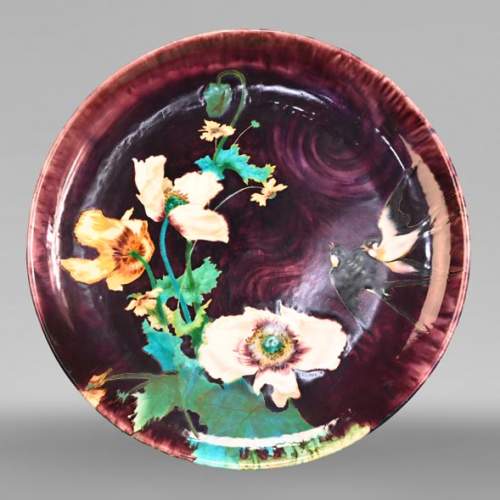
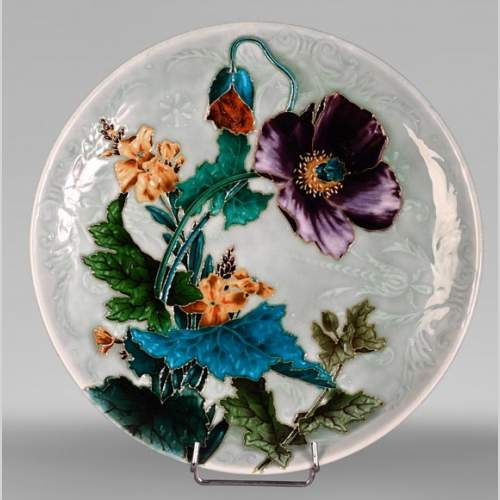
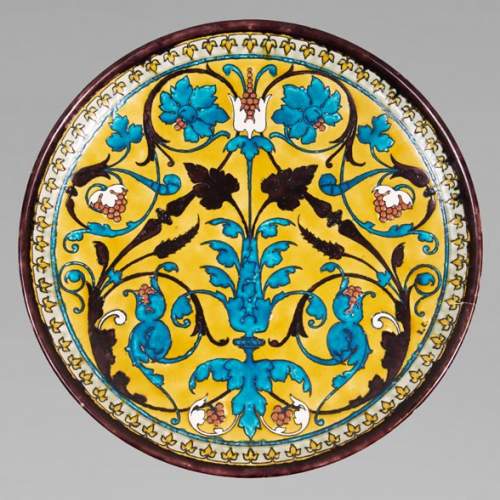
This ornamental dish decorated with poppy flowers and two swallows circling on an aubergine background was made in glazed ceramic by Théodore Deck (1823-1891) at the end of the 19th century. Théodore Deck initially trained as a stove maker. When he set up on his own in Paris in 1858, he made stove linings and, building on his success, moved into ceramics. The studio produced a large number of dishes, sometimes in collaboration with well-known painters. He gradually perfected his technique and enjoyed great success at the many World’s Fairs he took part in. In 1878, he was made an Officer of the Légion d’Honneur. He ran the Sèvres factory between 1887 and his death in 1891. This dish bears witness to the influence of Asian art on his work from the 1870s onwards: the dark background is set off by flat, brightly coloured, slightly shaded motifs, with no sense of depth. The stems, leaves and soft flowers are stylised, as they might be in Japanese prints. Finally, swallows are regarded very positively in Japan and are a recurring motif in that country’s art. The background of this dish is particularly elaborate, giving the illusion that the birds are swirling the air around them. The Marc Maison gallery is presenting another dish by Théodore Deck, in which brightly coloured flowers stand out against an aubergine background, as well as a dish created in collaboration with the painter Éléonore Escallier, in which tits and a bullfinch add life to the more plant-like pattern that surrounds them.

DAUM, Émile ROBERT (attributed to), Lamp in delicately openwork wrought iron and glass, circa 1900

Ref.15113
DAUM, Émile ROBERT (attributed to), Lamp in delicately openwork wrought iron and glass, circa 1900

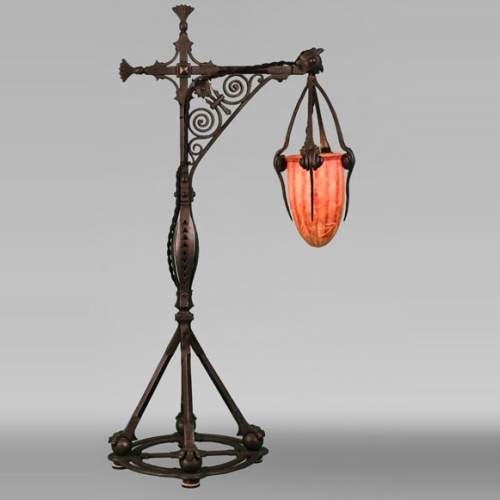
This lamp is the result of a collaboration between the Daum company, for the glass lampshade, and Émile Robert, for the wrought iron base. Founded in Nancy in 1878 by Jean Daum, the Daum glassworks was quickly taken over by his sons, Auguste and Antonin. From that moment on, increasingly complex creations from a technical point of view were designed there. Émile Robert (Mehun-sur-Yèvre, 1860-1924) quickly became skilled in artistic ironwork. When he arrived in Paris in 1878, he joined the workshop of locksmith Alphonse Gabriel Moreau, where his talent was quickly recognized, before becoming independent. At the 1900 Universal Exposition, he contributed to the decoration of the Metals Hall of the decorative arts pavilion, and even set up a workshop there to present the blacksmith's craft to visitors. In 1914, he founded a workshop in Enghien-les-Bains to undertake personal projects; in the same year, he was named a Knight of the Legion of Honor. This table lamp, with a base forming openwork wrought iron arms, is inspired by the Gothic style. It rests on an openwork circular base providing great stability. Four equidistant spheres topped by feet in the shape of stylized lion paws join to form a single base. Above, a slight bulge reflects Émile Robert’s interest in Art Nouveau and its vibrant vegetal vitality. The upper part, forming an arm, is decorated with delicate openwork scrolls and ends with a bird head from which the lamp is suspended. The lamp itself is conical, in orange glass tinged with yellow, held in place by four wrought iron scrolls also inspired by Art Nouveau forms. It is signed: “Daum Nancy ☨”.

Dimensions:
Width: 32 cm
Height: 63 cm
Depth: 22 cm