menu
Menu
account_box
Categories
Contact
email Send us a message

Contact

phone By phone

+33 (0)1 42 25 12 79
Tue.-Sat., from 10am to 6pm
+33 (0)6 60 62 61 90
Everyday from 9am to 7pm.

email by Email

Adress: contact@marcmaison.com

share Let's get social

Languages
And also...
My selection
(13 Objects)

My selection (13 Objects)


Mathurin Moreau for  the Val d’Osne Foundry,  The Four Elements,   between 1849 and 1879

Ref.15003
Mathurin Moreau for the Val d’Osne Foundry, The Four Elements, between 1849 and 1879

The son and brother of sculptors, Mathurin Moreau (Dijon, 1822-Paris, 1912) is one of the most reknown sculptors in the 19th century. He won the Second Prix de Rome at the age of 21. He worked for the Val d’Osne art foundry between 1849 and 1879. He won numerous prizes at the Salons and at the Universal Exhibitions; in 1897, he was awarded a medal of honour at the Salon. The sculptor was also a committed public figure: he published an essay on poverty in 1851 and was elected mayor of the 19th arrondissement in Paris in 1878. He created the Four Elements as part of his collaboration with the Val d’Osne art foundry at the end of the 19th century. The elements are personified by putti endowed with various attributes and accompanied by animals or objects echoing the element they evoke. Air, with its cheeks puffed out, blows into a foghorn; it sits on the body of a lamb with its eyes closed. Water is crowned with a reed and holds a long stick; the putto is riding a large sea turtle. Fire is holding a lighted lamp. He places his foot on a salamander, an animal reputed to be able to pass through flames without damage, or even to be engendered by fire. Lastly, Earth is crowned with a pampre and holds a bunch of grapes in one hand and a sheaf of wheat in the other. She is placing her foot on a wineskin. The artist’s eye for detail is visible in the different treatment of each putto’s hair. While Earth’s hair is natural, Air’s is made up of swirling curls and pulled back as if by a strong wind; Water's hair is soggy and almost similar to seaweed, while Fire’s imitates flames. Our set appears in the catalogue of the Société anonyme des grands fourneaux et fonderies du Val d’Osne. In 1878, a Four Elements fountain was erected in Valence, based on a model similar to the one in the foundry’s catalogue: the four statues in the lower basin are identical to ours.

Dimensions:
Width: 56 cm
Height: 118 cm

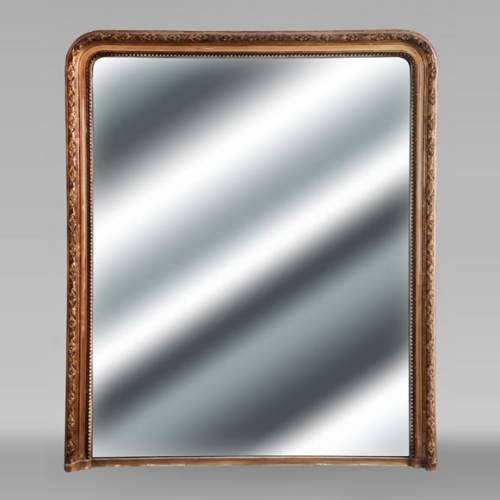
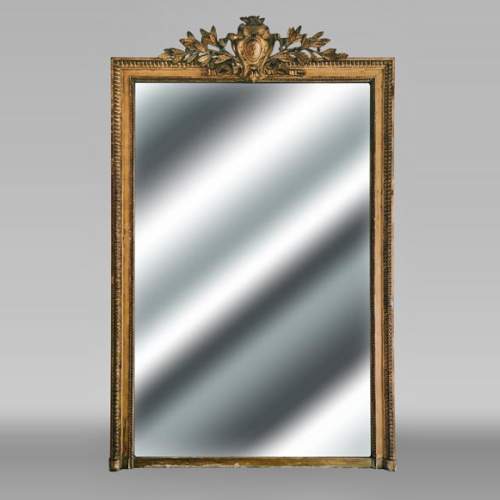
Napoleon III-style gilded trumeau with medallion

Dimensions:
Width: 107 cm
Height: 176 cm
Depth: 18 cm

Louis XV style Pompadour mantel in red Campan marble

Dimensions:
Width: 124 cm
Height: 103 cm
Depth: 35 cm
Inner width: 87 cm
Inner height: 84 cm

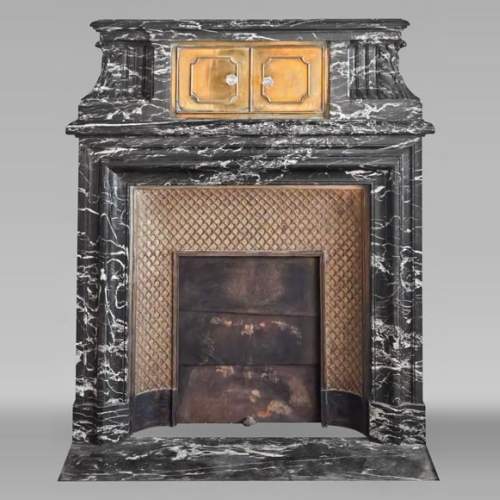
Louis XIV style mantel in fine black marble

Dimensions:
Width: 135 cm
Height: 109 cm
Depth: 36 cm
Inner width: 97 cm
Inner height: 88 cm

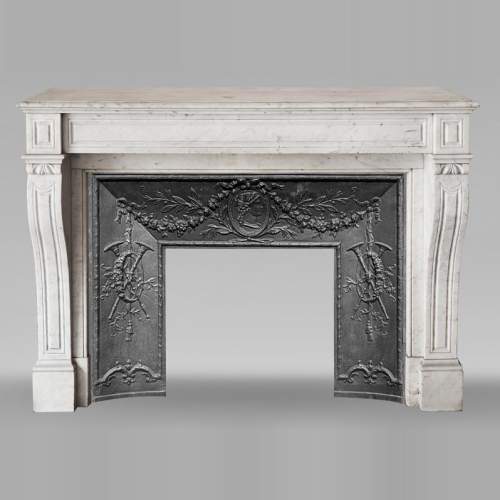
Louis XV style mantel in highly carved Carrara marble

Ref.5740
Louis XV style mantel in highly carved Carrara marble

This Louis XV-style Carrara fireplace stands out through its symmetrical and detailed sculpture. White Carrara marble, sometimes with gray veins, has brightening and delicacy qualities that enable the sculptor to work in fine detail. This fineness/delicacy can be seen over the band and fireplace’s legs. The band is thinner on the sides and thickens in the center, producing its curved shape. Thin and hollow moldings follow the contours of the band. In the band’s center, acanthus leaves create the shape of a sun. The leaf tips stand out slightly, creating volume. High-relief curled leaves skirt this central form. On the sides, two flowers with leaves extended on either side. At the top of the fireplace's legs, the central shape of the band is recreated by the acanthus leaves. We can notice that a flower from the acanthus leaves runs/gets down the length of the leg, moving to the right for the right foot and the left for the left. In the second part of the leg, there are four leaves following each other from the largest at the top to the smallest at the bottom. Flutes longing the length of the rest of the leg. These patterns are first hollowed and then filled in. This fireplace is accompanied by its symmetrical cast-iron interior that echoes the mantel's motifs. The center reuses the central pattern of the band formed by the acanthus leaves. In the hollow of the fireplace’s curves, a half-naked woman and a child are set in interlinked circles. These circles are themselves surrounded by intricate scrolls echoing the leaf motif.

Dimensions:
Width: 153 cm
Height: 107 cm
Depth: 41 cm
Inner width: 111 cm
Inner height: 81 cm

Carrara marble Louis XV mantel in the Pompadour style

Dimensions:
Width: 121 cm
Height: 105 cm
Depth: 36 cm
Inner width: 79 cm
Inner height: 88 cm

Louis XV style fireplace, Pompadour model, in blue Turquin marble

Dimensions:
Width: 124 cm
Height: 106 cm
Depth: 36 cm
Inner width: 86 cm
Inner height: 89 cm

Napoleon III style Capucine model fireplace in blue Turquin marble

Dimensions:
Width: 118 cm
Height: 97 cm
Depth: 37 cm
Inner width: 82 cm
Inner height: 74 cm

Louis XVI style fireplace with rounded corners, decorated with a daisy, in Carrara marble

Dimensions:
Width: 126 cm
Height: 107 cm
Depth: 33 cm
Inner width: 92 cm
Inner height: 88 cm

Napoleon III style fireplace with modillions, in blue marble

Dimensions:
Width: 123 cm
Height: 98 cm
Depth: 36 cm
Inner width: 84 cm
Inner height: 74 cm

Louis XVI style fluted fireplace, in Paonazzo marble

Dimensions:
Width: 131 cm
Height: 104 cm
Depth: 36 cm
Inner width: 85 cm
Inner height: 81 cm