Style Other / Ref.15640
Large cast iron public clock face, with raised Roman numerals, signed "GUIOTH A STENAY", 19th century
Dimensions
Depth: 7.5 cm / 3''
diameter: 133 cm / 52'' ⅜
Origin:
France, 19th century
Large circular public clock face (horloge d'édifice) in cast iron, from the belfry, bell tower or pediment of a public building. It bears the raised signature of the clockmaker, "GUIOTH", together with "A STENAY". Guioth à Stenay is the historic mark of J. Guioth, a celebrated clockmaker and mechanic established at Stenay (Meuse) during the 19th and early 20th centuries. His workshop specialised in the manufacture of movements for public and church clocks, several of which survive in the heritage of the Grand Est region — notably the clock face of the central rose window of the church of Saint-Amand at Chauvency-le-Château, and a cast iron and brass clock movement stamped "J. Guioth à Stenay" and dated 1888, recorded at Jonval.
The dial displays the classic vocabulary of monumental horology. The twelve hours are marked by large cast Roman numerals, boldly raised with pronounced serifs, arranged in a ring around the central aperture through which the hands passed. A raised minute track composed of small rectangular blocks runs around the entire circumference, while a hollow moulding underlines the rim. The signature is set out in two registers, "GUIOTH" beneath the XII and "A STENAY" above the VI, in keeping with the convention of monumental clock faces. The concave reverse retains its central hub and its threaded fixing rods, which secured the dial to the masonry or to the clock frame.
The cast iron has acquired a fine old patina, brown-black heightened with traces of gilding on the numerals and minute track — remnants of the original gilded scheme that made the dial legible from a distance — scattered with pitting and oxidation that testify to its long exposure to the elements. Robust and enduring, such monumental dials once equipped public and religious buildings and marked the passing hours in the life of towns and villages.
Informations
Price: on request
Recommended for you :
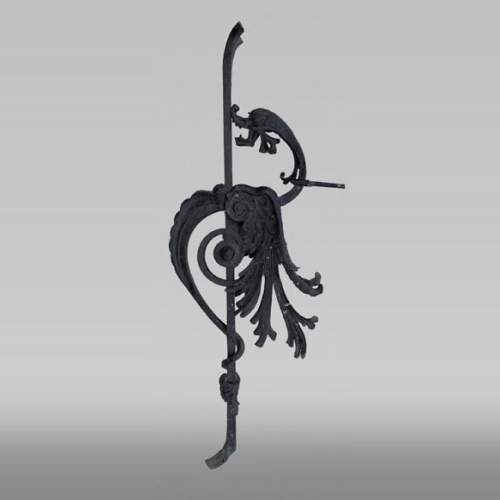
Dimensions:
Width: 20
Height: 144
Depth: 51
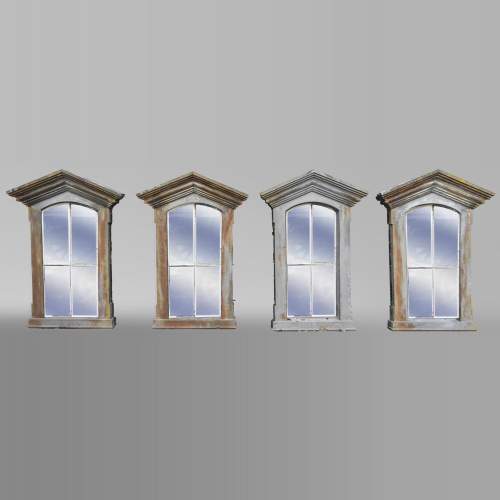
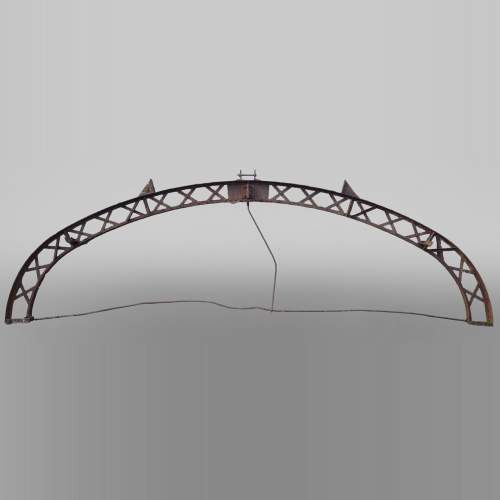
Dimensions:
Width: 580
Height: 177
Depth: 16
Inner width: 530
Inner height: 151
Dimensions:
Width: 502
Height: 49
Depth: 11
Dimensions:
Width: 153
Height: 481
Depth: 35

Dimensions:
Width: 129
Height: 135
Depth: 42
Dimensions:
Width: 39
Height: 35
Depth: 28
Dimensions:
Width: 176
Height: 450
Depth: 72
Dimensions:
Width: 30
Height: 41
Depth: 28
Dimensions:
Width: 345
Height: 225