menu
Menu
account_box
Categories
Contact
email Send us a message

Contact

phone By phone

+33 (0)1 42 25 12 79
Tue.-Sat., from 10am to 6pm
+33 (0)6 60 62 61 90
Everyday from 9am to 7pm.

email by Email

Adress: contact@marcmaison.com

share Let's get social

Languages
And also...
My selection
(8 Objects)

My selection (8 Objects)


MARCHAND Léon and PIAT Frédéric-Eugène, Elegant silvered bronze and enamel cartel clock in the neo-Gothic style

Ref.16783
MARCHAND Léon and PIAT Frédéric-Eugène, Elegant silvered bronze and enamel cartel clock in the neo-Gothic style

Silvered bronze, enamels. Hanging from a neo-Gothic gargoyle, the clock’s lower section is decorated with a pair of Chimeras with spread wings that bring much elegance to the sculpture. The use of silvered bronze and enamel make the clock’s face especially striking. The delicate character of the enamelwork is also heightened by the complete mastery of the metalwork whose elegant scrolls have been chased with great skill. Added to the medieval inspiration of the decoration, the iconography represents a wide variety of fantastic images that include arabesques held by a haughty looking eagle that terminates in dragon heads set into a background of stylized leaves. The pinnacle of the cartel, of Gothic inspiration, is the finishing touch of the upward movement of this clock.    The harmony of the composition, the makeup of the structure and the masterful demonstration of stylistic fusion are characteristic of the work of the ornamental sculptor Frédéric-Eugène Piat, artistic director of the Marchand company. Léon Marchand was a bronzeworker and art book publisher whose enterprise was founded by his uncle in 1820. He catered to a rich clientele that wanted their interiors decorated with refined works of art and small bronzes that reproduced older sculptures (such as Houdon’s statue of Voltaire) or contemporary masters, such as Charles Cumberworth (1812-1852). Marchand showed his work at the exhibitions of his time where he often won prizes, including a First Class Medal at the Universal Exhibition of 1855. His success is due in great part to Piat whose collaboration he secured by an exclusive contract and which the official catalogue of the Universal Exhibition of 1862 hailed saying, “His work, which is always new and original, has put this artist on the highest rung among the industrial manufacturers of our era.”One of their most famous creations was a perfume fountain, very similar to our clock, which was presented at the Universal Exhibition of 1867. One sees the same delicate arcs, Chimeras and pinnacle; only the clock’s face has been replaced by the fountain’s reservoir. The engraving of this fountain is incorporated in the illustrated catalogue of the Exhibition of 1867, thus emphasizing the great importance accorded to it by the jury who considered it the work of a master. 

Dimensions:
Width: 30 cm
Height: 116 cm

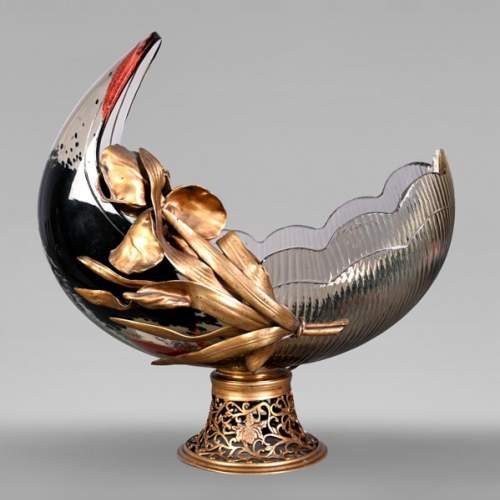
CHRISTOFLE - Exceptional planter in electroplated copper, partially copper colored, gilt, silvered and burnished on a silver background, circa 1878

Ref.13653
CHRISTOFLE - Exceptional planter in electroplated copper, partially copper colored, gilt, silvered and burnished on a silver background, circa 1878

This exceptional planter was produced by the silver company Christofle from a model by the architect and theorist Emile Reiber (1826-1893), then chief of the house’s drawing workshop since 1865. Strongly marked by the Japanese or Chinese bronzes, Emile Reiber is one of the Japonisme leader in the decorative arts in France. He is especially inspired by the Japanese mixed-metal objects called Mokume, for his tries on the polychromatic research. Thus, he composed colored models for the Christofle company made thanks to the electroplated technique, of which the French rights of the Elkington’s patent were bought by Charles Christofle (1805-1863), founder of the house, in 1842, then really developed by Henri Bouilhet in the workshops. It’s this way that Emile Reiber permits the company to renew its production in the 1870’s, by creating a collection of original decorative pieces mainly Japan inspired. They were particularly noticed during their presentation in the World Fairs of Vienna in 1873 and Paris 1878, making of Christofle, the silversmith of the colored bronze. Since its origins, Christofle has followed the tastes of its time, reflecting the artistic movements in vogue. From the Monarchy of July to the late 19th century, prevail the eclecticism and the naturalism, while the East favors the research for new decors. On the Orientalism and Japonism momentum, nature inspires the production of objects and places progressively on the market objects with various shapes and decorations. Thus, the plants theme in the decor is generalized in the 1880’s. To always better renew its decorative vocabulary, the most important French Silver house of the second half of the 19th century, occasionally asks famous artists to work for them. It’s this way that Emile Reiber draws the model of our planter edited in diverse colors, on black or red backgrounds. Presenting a decor in the Japanese taste, the silver colored body of our gardener shows a decor composed of copper colored quince flowers with burnished leaves and also burnished cherry tree branches. It rests on gilt bronze feet taking the shape of pine cones that we also find on the handles. The different metallic shades are obtained thanks to the electroplated technique. Similar in its principle to the gilding or the silver plating, the electroplating is a fabrication proceed which is a ruthless competitor to the different cast iron techniques. The aim is to allow the metal reproduction of any object, whatever its nature. The huge advantage of this technique compared to the cast iron is to make an object immediately perfect, without mending or carving it.

Dimensions:
Width: 45 cm
Height: 14 cm
Depth: 29 cm

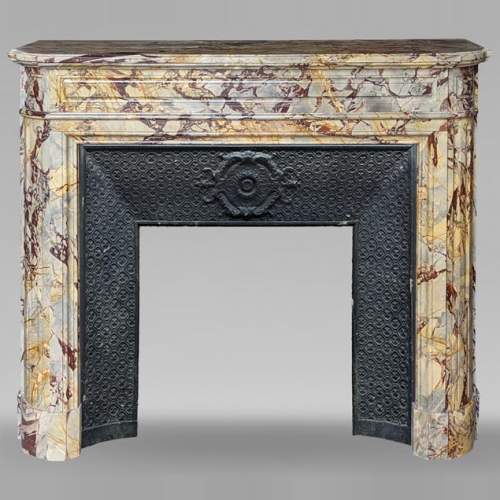
Louis XIV style mantel with acroterion in Rouge du Nord marble

Dimensions:
Width: 146 cm
Height: 115 cm
Depth: 35 cm
Inner width: 115 cm
Inner height: 87 cm

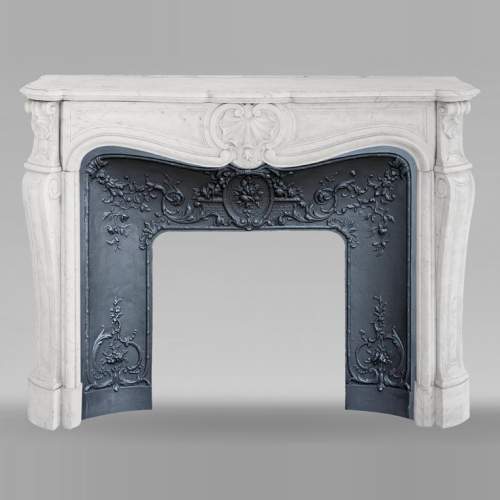
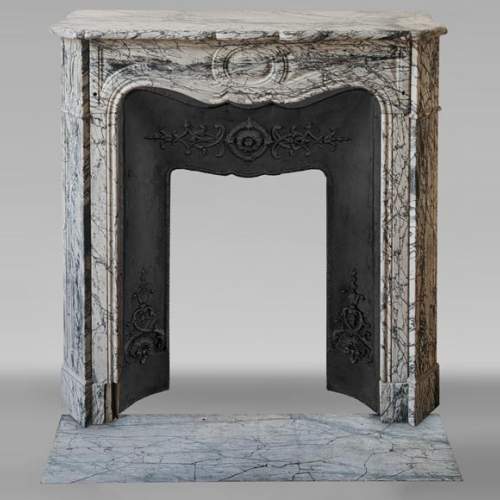
 Large Louis XV style fireplace decorated with a large shell, in Seravezza marble

Dimensions:
Width: 168 cm
Height: 118 cm
Depth: 45 cm
Inner width: 128 cm
Inner height: 97 cm