menu
Menu
account_box
Categories
Contact
email Send us a message

Contact us

phone By phone

+33 (0)1 42 25 12 79
Tue.-Sat., from 10am to 6pm
+33 (0)6 60 62 61 90
Everyday from 9am to 7pm.

email by Email

Adress: contact@marcmaison.com

share Let's get social

Languages
And also...
My selection
(4 Objects)
My selection (4 Objects)
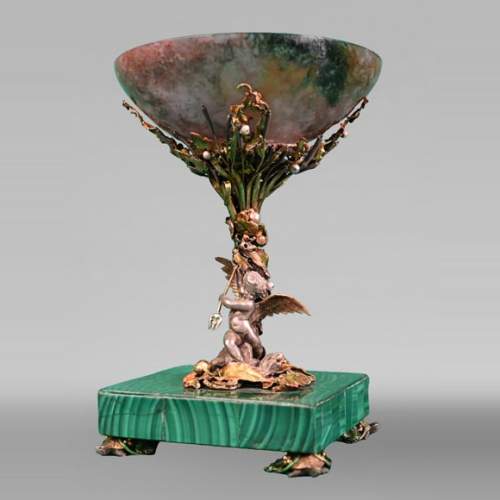

François-Désiré FROMENT-MEURICE, Silver, Agate and Malachite Tazza Decorated with a Rich Maritime Design, 1853

Ref.14918
François-Désiré FROMENT-MEURICE, Silver, Agate and Malachite Tazza Decorated with a Rich Maritime Design, 1853

This splendid cup with a marine decor was created by François-Désiré Froment-Meurice in 1853. The son of a modest goldsmith who died shortly after his birth, François-Désiré Froment-Meurice took over the goldsmith manufacturing business of his stepfather, Pierre-Jacques Meurice, in 1828; a few years later, he also inherited that of a jeweler and goldsmith merchant. At the 1839 Exhibition of Industrial Products, Froment-Meurice already bore the title of “goldsmith jeweler of the city of Paris”. His highly acclaimed exhibition earned him a double silver medal in goldsmithing and jewelry. At the 1844 Exhibition of Industrial Products, he was awarded a gold medal. His inspiration was eclectic, and the techniques and materials used were varied (hard stones, enamel, niello, repoussé…). Among other things, he exhibited commissions from the city of Paris, a chalice intended for the pope, and the Harvest Cup acquired by the Duke of Montpensier. At the 1849 exhibition, he received a gold medal recall; notably, the table centerpiece commissioned by the Duke of Luynes and the first elements of the dressing table intended for the Duchess of Parma, designed by Duban, were particularly admired. The entire dressing table (table, mirror, candelabra, caskets) was presented in London at the Great Exhibition of 1851, where its virtuosity ensured Froment-Meurice’s triumph. The goldsmith died, at the height of his glory, shortly before the 1855 World’s Fair. At his death, his son succeeded him and later became one of the most brilliant goldsmiths of the Second Empire. This cup, combining malachite veneer, partially gilded and enameled chiseled silver, and moss agate, was created precisely at the end of his career. It fits perfectly into his production of extremely refined small objects. Four turtle-shaped feet support a malachite veneered base using the so-called “Russian mosaic” technique. From this base rises the silver stem, whose abundant and delicate decor forms the very structure. At the base, on a bed of aquatic plants, a cupid brandishing a trident set with a pearl subdues a sea monster. Above, aquatic plants also hosting pearls flourish, culminating in a motif of reeds supporting the moss agate cup. The delicacy of the silver chiseling is matched only by the subtlety of its color variations. The whole piece echoes the artist’s taste for 16th-century goldsmithing. Eclecticism and historicism indeed hold a privileged place in his work. Froment-Meurice created another equally precious cup, also inspired by Renaissance goldsmithing. This is the so-called “Harvest Cup”, now kept at the Louvre Museum in Paris.

Dimensions:
Width: 11 cm
Height: 20 cm
Depth: 10 cm

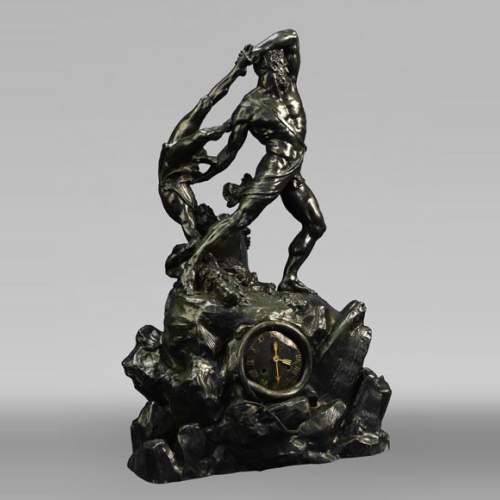
Antonio CANOVA (after), INGÉ and SOYER (attributed to), Clock “Hercules and Lichas”, circa 1840

Ref.13372
Antonio CANOVA (after), INGÉ and SOYER (attributed to), Clock “Hercules and Lichas”, circa 1840

Antonio Canova (after), Ingé and Soyer (attributed to), Hercules and Lichas Clock, circa 1840 This clock, made around 1840, is attributed to the founders Ingé and Soyer. The sculpture was executed after Hercules and Lichas (1795-1815), a marble by Antonio Canova (1757-1822) preserved at the National Gallery of Modern and Contemporary Art in Rome. Ingé and Soyer partnered from 1831. They notably participated in the 1834 Exhibition of Industrial Products, where they exhibited among other works “the group of Canova’s Hercules” (Baron Charles Dupin, Report of the Central Jury on the Products of French Industry Exhibited in 1834, Paris, 1836, vol. 3, p. 140), which is found on our clock. During the exhibition, they received a silver medal for “the excellence of [their] production, remarkable for the perfection of the sand casting and the chiseling work” (Catherine Chevillot and Laure de Margerie, Sculpture in the 19th Century: Essays for Anne Pingeot, 2008, Éditions Nicolas Chaudun). The subject of the sculpture is drawn from chapter IX of Ovid’s Metamorphoses. Lichas had been tasked by Deianira to deliver Nessus’s tunic to her husband. However, when Hercules felt his body being consumed, thinking that he had betrayed him, he grabbed him by the foot and threw him into the Euboean Sea. The presence of the rocks at the base of the clock recalls that, according to Ovid, Lichas then transformed into a rock. The snake encircling the clock face aligns with the Herculean theme, echoing Hercules’ first labor of strangling the snakes placed in his cradle by the goddess Hera. Canova’s marble sculpture, created in 1795, enjoyed great popularity in France. The sculptor had indeed sent it to Quatremère de Quincy, one of the great advocates of his art in France, who probably contributed to the dissemination of this model. It was subsequently cast by Ingé and Soyer, who also adapted it for our clock. This rock and the clock face were identically reused for another of their clocks, called “Saint Michael the Archangel, Conqueror of Satan, Announcing the Reign of God”, housed in the Louvre. This clock is topped with a sculpture by Jehan Duseigneur. It was signed by Duseigneur and by the founders Ingé and Soyer, providing the final clue linking our clock to their work.

Dimensions:
Width: 43 cm
Height: 62 cm
Depth: 23 cm

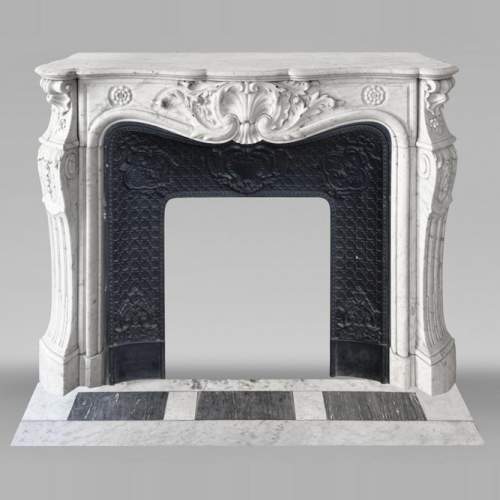
Louis XV style fireplace adorned with a large shell

Dimensions:
Width: 143 cm
Height: 106 cm
Depth: 40 cm
Inner width: 97 cm
Inner height: 87 cm