


Style Louis XV / Ref.16000
Emmanuel ZWIENER (cabinetmaker) and Léon MESSAGÉ (bronze maker), Large Louis XV style bed in precious wood marquetry and gilt bronze, formerly in the collection of Charles Tyson Yerkes, 1895
Dimensions
Width: 210 cm / 82'' ⅝
Height: 210 cm / 82'' ⅝
Depth: 250 cm / 98'' ⅜
Origin:
France, 19th century
Status:
Good condition
Combining the excellence of the cabinetmaker Emmanuel Zwiener with the inspired designs and sculptural virtuosity of Léon Messagé, this bed, impressive in its proportions and magnificence, is a masterpiece of Belle Époque cabinetmaking.
Emmanuel Zwiener
According to the most recent research, the three Zwiener brothers came from Herdon, in Germany (J. Meiner, Berliner Belle Epoque. Der Ebenist Julius Zwiener und die Kunstmöbel für den Hof Kaiser Wilhelm II. 1888-1918, 2014). The eldest, Joseph, had established a large workshop in Breslau, Silesia (now Wrocław, Poland) in the 1880s. His younger brothers, Emmanuel and Julius, were then working in Paris. From 1880, their workshops at 12, rue de la Roquette produced luxury furniture, including replicas of the royal models kept at the Garde-Meuble National, such as the famous King's desk designed by Jean-Henri Riesener and Jean-François Oeben. Their creations, however, offered a renewed interpretation of the French rocaille style. As this piece shows, Zwiener's furniture is often decorated with delicate marquetry and rich, finely chased gilt bronze mounts. In 1895, after receiving a major commission from Emperor Wilhelm II of Prussia, Julius returned to Berlin to found his own workshops. That same year, Emmanuel retired from cabinetmaking and sold his workshop on rue de la Roquette to Jean-Henri Jansen (1854-1929), founder of the Maison Jansen, for 10,000 francs.
Léon Messagé
Gilt bronze mounts and sculptures were the crowning glory of the finest furniture of the late 19th century. Léon Messagé excelled in the design and execution of these ornaments. Drawing on the asymmetry of the rocaille style made popular in the 1720s by Parisian ornamentalists such as J.-A. Meissonnier, Messagé created allegorical figures in high relief, framed by delicate organic structures in gilt bronze.
Awarded a gold medal at the 1889 Exposition Universelle in Paris for a jewel cabinet made with Zwiener, he published in 1890 his Cahier des Dessins et Croquis Style Louis XV, containing thirty-six designs for furniture and objets d'art. It was through his collaboration with Zwiener that Messagé first came into contact with François Linke, with whom his name remains most often associated. Messagé usually retained the rights to his models, which allowed him to adapt them to various uses. His mounts therefore appear on the furniture of several different cabinetmakers.
The iconography
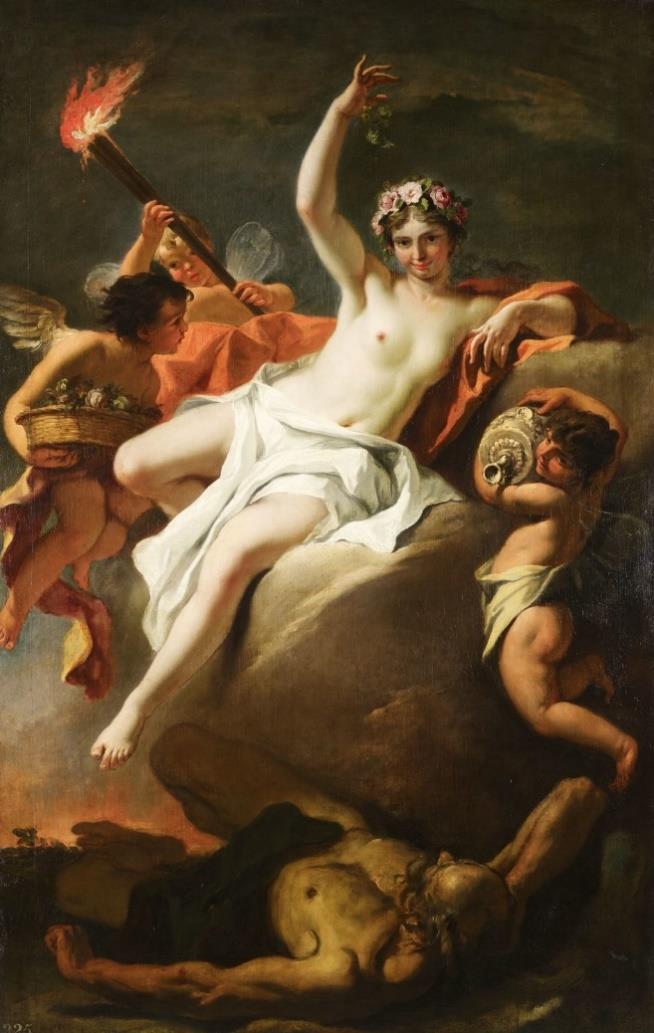
The headboard, in the shape of a shell, is surmounted by a sleeping putto, Eros or Cupid, resting on the helmet of Mars, a symbol of the victory of love over war. Whoever sleeps in this bed, even the god of war or the master of the universe, is thus invited to set aside his cares and enter the world of dreams. The headboard is flanked on either side by two espagnolettes: the first shields her eyes from the rising sun, while the second covers her face to evoke nightfall. Messagé's masterpiece is found at the foot of the bed, where a large gilt bronze cartouche, alternating low and high relief, depicts the personification of Dawn preceding the rising sun. The bed frame is decorated with an asymmetrical shell and a dolphin in gilt bronze.
A genesis linked to the American Gilded Age
Charles Tyson Yerkes
Charles Tyson Yerkes (1837-1905) was born into a Philadelphia Quaker family. An investment banker, he made a fortune and earned a reputation as a financial genius. However, he lost his fortune in 1871, when the Great Chicago Fire caused the collapse of the Philadelphia Stock Exchange. He was charged with embezzlement, tried and sentenced to two years and nine months in prison, of which he served seven months before being pardoned. He began making money again in the 1880s in Chicago, this time in streetcars and suburban railways, and eventually controlled the syndicate of companies operating Chicago's public transport system. A philanthropist on the scale of his immense fortune, Yerkes funded in 1892 the construction of an observatory for the University of Chicago, which then housed the largest telescope in the world. A great patron, he ensured through generous financial contributions that the 1893 World's Columbian Exposition was held in Chicago rather than in Washington or New York; he also sat on the exposition's Fine Arts committee. At the same time, Yerkes met the curator Sara Tyson Hallowell (1846-1924), who was assistant chief of the Fine Arts department of the 1893 World's Columbian Exposition while also working for Chicago art collectors. She helped him build his own art collection, which was to become one of the most important in the country. Yerkes was notably the patron of the Belgian artist Jan Van Beers (1852-1927), whose portrait of him was shown at the Columbian Exposition and is now in the National Portrait Gallery of the Smithsonian Institution.
Yerkes's business dealings, however, earned him many enemies, and in 1899 he left Chicago for New York. There he had a sumptuous mansion built on the southeast corner of Fifth Avenue and 68th Street, one of the most sought-after locations in New York's most prestigious residential district. He turned it into a veritable art gallery, which he later enlarged by acquiring the neighbouring mansion at 860 Fifth Avenue.
"Yerkes knew what he was doing: in ten years he had accumulated a personal fortune estimated at $29,000,000. His gift of a fountain to Lincoln Park cost him $25,000, and his donation to the University of Chicago [...], more than $1,000,000. He had a $1,000 carriage, a $1,700 piano and a $50,000 tomb in Greenwood Cemetery. In 1896 he owned one of the finest art collections in the world, including two Rembrandts, several Rubens, a Van Dyck, a Turner valued at $67,000 and a portrait of himself said to be worth $30,000. His unique collection of oriental objects surpassed that of the Shah of Persia. When Yerkes travelled East on business, he stayed in his Fifth Avenue house in New York, worth $1,500,000, and slept in an $80,000 bed that had once belonged to the King of Belgium."
The piano mentioned appears in the sale catalogue of Charles Yerkes's collection as lot 354: "An Erard concert piano with Vernis-Martin", painted "in the style of Watteau and Fragonard" and fitted with "remarkable gilt bronze mounts made by the celebrated house of Zwiener, in Paris, for Mr. Yerkes in 1896". It was accompanied by lot 355: two piano stools "decorated with gilt bronze mounts by Zwiener" (Catalogue de Luxe of the Ancient Rugs, Sculptures, Tapestries, Costly Furniture and Other Objects Belonging to the Estate of the Late Charles T. Yerkes, New York, 1910, no. 354).
Sara Tyson Hallowell (1846-1924), who had organised the loan of French works of art to the 1893 Chicago World's Fair, was Charles Yerkes's art adviser. Hallowell deeply admired the work of Auguste Rodin and had arranged for three of his nudes to be shown at the Exposition. Because their nudity caused controversy, the sculptures were hidden behind a curtain, and visitors who wished to see them had to request special permission. Although Yerkes was initially sceptical, Hallowell persuaded him to buy two Rodin marbles, Cupid and Psyche and Orpheus and Eurydice, for his Chicago mansion. These were the first two Rodin sculptures acquired by an American collector; they were sold as lots 250 and 251 at the 1910 auction, then donated that same year by the magnate Thomas F. Ryan (1851-1928) to the Metropolitan Museum of Art. Hallowell was also adviser to Bertha Honoré Palmer, wife of the Chicago real estate developer Potter Palmer, who assembled an important collection of French Impressionist paintings that today forms much of the core of the Impressionist collection of the Art Institute of Chicago. In 1894, Hallowell settled in Paris, where she continued to select works of art personally for American collectors. As our bed is dated 1895, when she was working from Paris, she may have supervised its commission.
The bed stood in the "Louis XV" bedroom of Charles Yerkes's mansion, as shown by the photographs published in the 1910 sale catalogue of his collection. It is described there under number 856: "Gorgeous Louis XV Bedstead. Made by Zwiener, of Paris. Executed in palissandre and marquetterie, with superlative ormolu bronze mounting. Cast from specially prepared models, of which some were used only on one occasion before (for Ludwig II., the late King of Bavaria, and destined for the Royal Hohen-Schwangau Palace). This applies especially to the large ormolu figures in torso, with accompanying ornaments, that form the posts on head-piece; as also to the sleeping cupid surmounting the centre, with the helmet of Ægis. The foot-board, which was especially modelled for Mr. Yerkes, sustains other cupids in free relief, that hold up draperies, revealing radial rays of the rising sun, forming a background for the large couchant figure of a nymph. This composition allegorically represents the Dawn of Morning, as the head-piece, with its sleeping amour suggests Night. These castings, besides being most carefully chased, are gilt in the old mercury process."
Joseph Raphael De Lamar
The bed's second owner was Captain Joseph Raphael De Lamar (1843-1918), who acquired it for his mansion on the corner of Madison Avenue and 37th Street. Born in the Netherlands, Joseph De Lamar spent his youth at sea, first in the merchant navy, then, during the American Civil War and the years that followed, as a successful submarine contractor. During the Leadville gold rush in Colorado in 1878, De Lamar gave up his maritime business and headed West to buy several mining claims. Shortly afterwards, he bought the "De Lamar mines", which he sold two years later at a considerable profit, having already extracted large quantities of gold and silver. He remained either sole owner or principal shareholder of several other mining companies, and his growing fortune made him one of the country's leading financiers and a major figure on Wall Street for twenty years. In 1888, De Lamar settled in New York, where he lived for the rest of his life, apart from a few years spent in Paris at the turn of the century. His mansion, built in 1904, still stands today and houses the Consulate General of the Republic of Poland.
The 1919 auction catalogue makes it clear that Captain De Lamar was a client of François Linke, Zwiener's contemporary, and that he acquired several important pieces that Linke had exhibited at the 1904 Saint Louis World's Fair, including lot 520, one of the two known versions of the Bahut Marine, which had also been shown at the 1900 Exposition Universelle in Paris (see Christie's, London, 9 December 2010, lot 257 (£780,450)).
De Lamar also acquired from François Linke, or at the sales of other important New York clients of Linke during the previous decade, many remarkable pieces, including:
- Lot 347: an ornate dressing table (see Christie's, London, 20 March 2003, lot 191).
- Lot 380: a marquetry dressing table (see Sotheby's, New York, 16 November 2011, lot 279).
- Lot 422: a large four-sided centre vitrine (from the George Crocker sale, held 4-6 January 1912).
- Lot 423: a unique settee, with reversed mounts matching those of the Bahut Marine (bought at the Isaac D. Fletcher sale, 22-23 November 1918).
- Lot 485: the Grande Bibliothèque, one of three made (see Sotheby's, Monaco, 25-26 October 1981, lot 111).
- Lots 517-519: a complete dining room (see Christie's, London, 20 March 2003, lot 192 (£548,450)).
- Lot 523: a Régulateur Louis XV surmonté du motif Le Temps, one of three examples made.
Given the impressive scale of De Lamar's collection of furniture by François Linke, it is not surprising that the 1919 American Art Association catalogue wrongly attributes the present bed to Linke: "Lot 345: Louis XV style bed in marquetry of kingwood, mahogany and gilt brass, by Linke." However, the provenance is correctly given as "from the Charles T. Yerkes collection, 1910", where the bed had been correctly attributed to Zwiener. The bed is recorded as sold, with its canopy (lot 346), for $2,000 to "Lans & Co.", probably Lans Antiques, which had a gallery, the Lans Building, at 554 Madison Avenue, New York.
After 1919, the history of this spectacular bed is no longer precisely documented. Christopher Payne recalls seeing a photograph from the 1960s showing it at George Amos, an antique dealer in Indianapolis. The exact date on which it entered the collection of Mrs J. C. Maxwell, of Fort Worth, Texas, is unknown; part of her collection was sold at Christie's East in 1987, before the sale of her estate in 1992.
The sale of this bed offers a rare opportunity to acquire one of the most emblematic and spectacular creations of Belle Époque cabinetmaking. Its magnificence surpasses that of any other bed made by Zwiener, or even by his contemporary François Linke. Commissioned by an art-collecting baron of the American Gilded Age, this grand bed represents the ultimate achievement of Emmanuel Zwiener's Parisian production, executed in 1895, just before the sale of his workshop, his retirement and the founding of his brother Julius's Berlin workshops.
Provenance:
- Commissioned by Charles Tyson Yerkes (1837-1905) for his mansion at 864 Fifth Avenue, New York; sold on the premises by the American Art Association, New York, 11-13 April 1910, lot 856.
- Captain Joseph R. De Lamar for his mansion at 233 Madison Avenue; sold on the premises by the American Art Association, New York, 20-22 November 1919, lot 345.
- With Lans & Co., New York.
- Property from the estate of Mrs J. C. Maxwell, Fort Worth, Texas, sold at Christie's East, New York, 5 November 1992, lot 401.
Literature:
- C. Mestdagh, L'Ameublement d'art français. 1850-1900, Paris, 2010, p. 195, fig. 224, illustrated.
- C. Payne, Paris Furniture: The Luxury Market of the 19th Century, Paris, 2018, p. 362, illustrated.
Dimensions:
Overall: 244 cm long
Headboard: 215 cm high; 215 cm wide
Footboard: 112 cm high; 198 cm wide
Mattress: 213.5 cm long; 160 cm wide (corresponds to a Queen size bed)
Informations
Price: on request
Recommended for you :
Dimensions:
Width: 168
Height: 235
Depth: 55
Dimensions:
Width: 157
Height: 267
Depth: 208
Dimensions:
Width: 159
Height: 255
Depth: 55
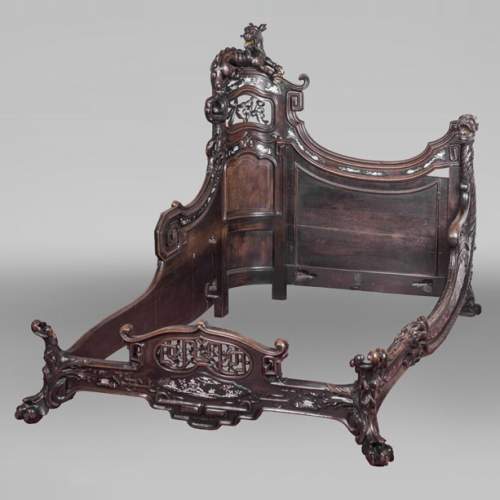
Dimensions:
Width: 132
Height: 160
Depth: 221
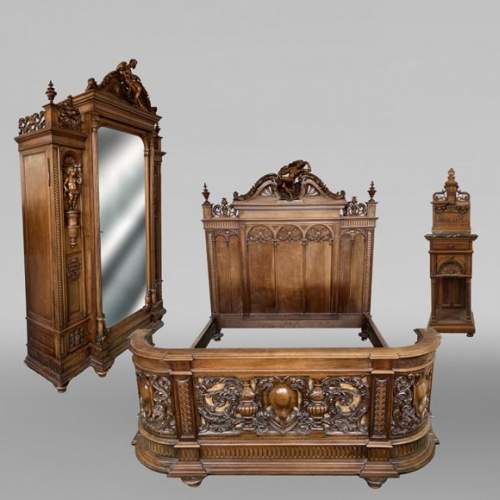
Dimensions:
Width: 221
Height: 289
Depth: 185
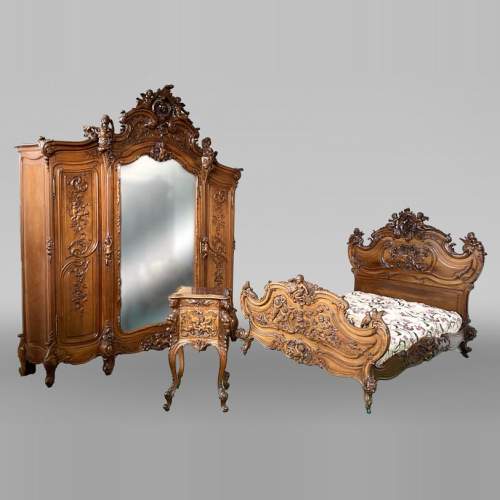
Dimensions:
Width: 234
Height: 276
Depth: 218
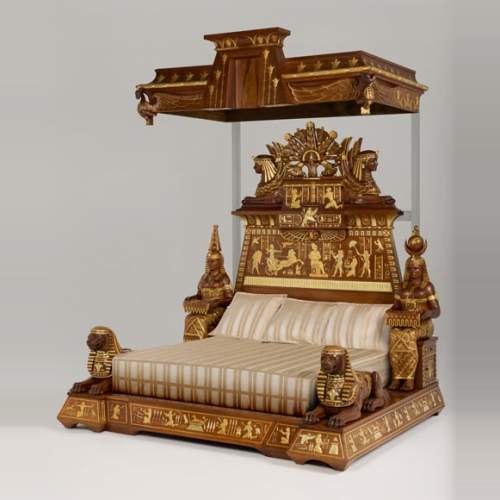
Dimensions:
Width: 260
Height: 345
Depth: 232
Dimensions:
Width: 238
Height: 86
Depth: 95

Dimensions:
Width: 258
Height: 201
Dimensions:
Width: 166
Height: 144
Depth: 224

Dimensions:
Width: 155
Height: 255
Depth: 225
Dimensions:
Width: 159
Height: 258
Depth: 211