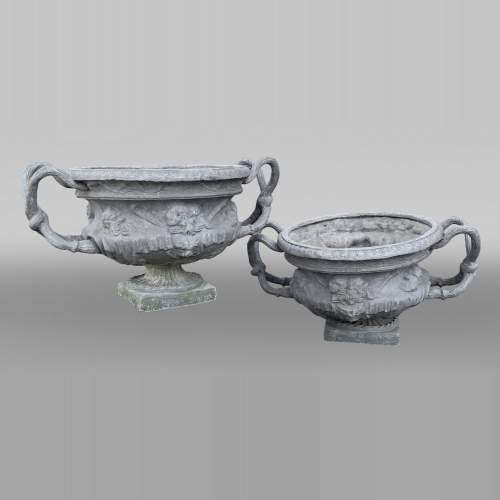
Style Napoleon III / Ref.16223
Cast iron garden vase with a frieze of cupids and handles formed as winged putti
Dimensions
Height: 59 cm / 23'' ¼
Depth: 46 cm / 18'' ⅛
Origin:
France, second half of the 19th century.
Status:
In need of restoration. Thick white paint covering several earlier campaigns, dark blue, light blue and pink, visible in the losses and inside the bowl. General flaking. Oxidation around the base.
Cast iron garden vase of flared form, resting on its socle and octagonal base.
The bowl widens towards the top and ends in a broadly overhanging lip, carried on a gadrooned belly, a socle and a base. This calyx form with projecting lip draws on antique kraters without reproducing any named model. The underside of the lip is decorated with a band of vine and grapes worked in low relief, continuing around the edge in a row of veined leaves. The lower part of the bowl is ordered by a row of full gadroons, separated by slender foliate falls that die away against the moulding of the socle.
The frieze of the belly forms the essential of the decoration. At the centre, a cupid seated on a cloud holds above him a length of drapery gathered in one hand, while his other arm encircles a second child reclining at his feet. On either side unfold garlands of fully opened flowers, roses, anemones and poppies, each corolla individually rendered, their stems falling in festoons down to the handles.
The handles are figural. Each is formed as a winged putto, draped to the waist, the torso standing in high relief clear of the belly and the arm folded above the head, the body bending and continuing into a foliate fall that rejoins the belly at the level of the gadroons. This treatment, substituting the figure for the scroll, required casting in several pieces and careful fettling, the result of which remains legible beneath the paint.
The decoration belongs to the Second Empire taste for the eighteenth century, in which cupids and flower garlands take the place of the sacrificial repertoire of antiquity. It is the usual formula of the great French art foundries of the period, Val d'Osne, Durenne at Sommevoire, Ducel at Pocé-sur-Cisse or Barbezat, which adapted classical silhouettes by applying decoration of their own time.
The octagonal base, with faces of 10 cm, less common than the square or circular plinth, is a distinctive feature of the model.
Informations
Price: on request
Recommended for you :
Dimensions:
Width: 99
Height: 167
Dimensions:
Height: 117
Diameter: 80
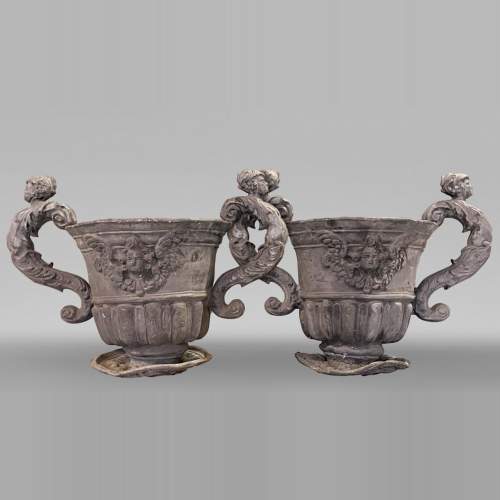
Dimensions:
Width: 59
Height: 44
Depth: 32
Dimensions:
Width: 98
Height: 34
Depth: 33
Dimensions:
Width: 102
Height: 100
Depth: 80
Dimensions:
Height: 78
Diameter: 43
Dimensions:
Width: 68
Height: 112.5
Diameter: 70
Dimensions:
Width: 55
Height: 68
Depth: 55
Diameter: 55